The air inside the Voskhod 2 capsule smelled of stale sweat and recycled oxygen, a cramped metallic womb hurtling through the vacuum at 17,000 miles per hour. Alexey Leonov, a man whose childhood was forged in the brutal winters of Siberia, sat shoulder-to-shoulder with his commander, Pavel Belyayev. They were encased in layers of nylon, rubber, and hope. Outside the curved glass of their porthole, the sun didn't just shine; it screamed with a brightness that could blind a man in seconds.
History remembers March 18, 1965, as a day of triumph. The headlines shouted that the Soviet Union had leaped ahead in the Space Race, placing a human being directly into the abyss for the first time. But headlines are polished stones. They don't capture the sound of a man’s pulse thundering in his ears or the terrifying realization that his own suit is trying to kill him.
The Threshold of the Impossible
To understand the stakes, you have to forget everything you know about modern, sleek space travel. In 1965, Leonov wasn't stepping out of a high-tech laboratory. He was stepping out of a pressurized tin can. The technology was experimental, the calculations were often done with slide rules, and the margin for error was non-existent.
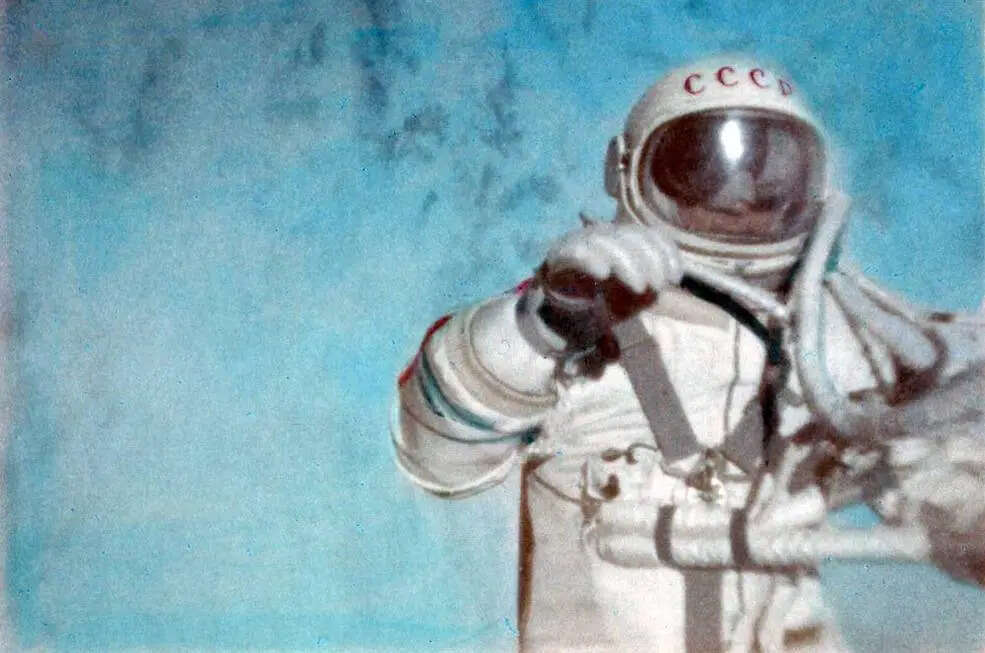
Leonov entered the Volga, an inflatable airlock that looked more like a piece of camping equipment than a gateway to the stars. When the outer hatch swung open, he didn't just see the Earth. He saw the infinite. He floated out, tethered by a slender five-meter umbilical cord that was his only link to life. For twelve minutes and nine seconds, he was a satellite. He felt the curve of the world beneath him—a brilliant, fragile marble of sapphire and cloud. He was, for a brief moment, the loneliest and most privileged human being in existence.
Then, the physics of the vacuum began to assert itself.
The Suit That Became a Cage
Within minutes, Leonov noticed something wrong. The lack of external atmospheric pressure meant the air inside his Berkut spacesuit was pushing outward with immense force. It wasn't just a garment anymore; it was a rigid, bloated balloon. His gloves expanded until his fingers could no longer reach the tips. His boots pulled away from his feet.
He was a prisoner inside his own protection.
As he tried to pull himself back toward the airlock, he realized he couldn't move his limbs. The suit had become so stiff that bending a joint required the strength of a weightlifter. Every movement was a battle against internal pressure. He was sweating profusely, his body heat rising as the suit's cooling system failed to keep up with his exertion. His vision began to fog. The sun, once a marvel, was now a heat lamp cooking him alive.
Leonov faced a choice that would haunt any engineer. He could radio Moscow and wait for instructions that might never come, or he could take a gamble that defied every safety protocol in the book. He reached for a valve on his suit.
He began to bleed oxygen into the vacuum.
It was a slow suicide if he didn't move fast enough. By lowering the pressure in his suit, he risked the "bends"—nitrogen bubbles forming in his blood, a condition that causes agonizing pain and death. But it was the only way to make the suit flexible enough to squeeze back into the airlock. He didn't tell ground control. He didn't ask for permission. He just breathed out, watched his gauges drop, and fought his way back through the narrow tube.
The Oxygen Crisis in the Dark
The nightmare should have ended when the hatch hissed shut. Instead, it shifted into a more subtle, terrifying gear. As Leonov and Belyayev prepared for reentry, they noticed a spike in the cabin’s oxygen levels.
A stray spark. A flick of a switch. In a pure oxygen environment, that’s all it takes to turn a spacecraft into a furnace. They watched the dial creep upward. The automated systems were malfunctioning, pumping the cabin full of the very gas that kept them alive but now threatened to incinerate them. They sat in stony silence, moving as little as possible, terrified that a static shock from their suits would trigger an explosion.
They were two men sitting on a bomb, waiting for the clock to run out.
For hours, they hovered on the edge of catastrophe. Eventually, the pressure stabilized, but the universe wasn't finished testing them. The automatic landing system failed. Belyayev had to manually pilot the craft back into the atmosphere—a feat of coordination and nerves that had never been done at those speeds.
The Cold Silence of the Taiga
When the Voskhod 2 finally slammed back into Earth, it didn't land on the grassy plains of Kazakhstan as planned. It overshot the mark by 2,000 kilometers.
The cosmonauts looked out their window and didn't see recovery teams. They saw the Ural Mountains. They saw ancient, towering fir trees and snow that was two meters deep. The temperature was minus 30 degrees Celsius.
They had survived the vacuum of space and the threat of fire, only to find themselves in the middle of a primeval wilderness populated by wolves and bears during mating season. Their electronics were dead. Their heater was broken. They spent the first night huddled together in their sweat-soaked suits, listening to the wind howl through the trees, knowing that even though they had conquered the stars, the Earth could still swallow them whole.
Rescue didn't arrive for two days. When the ski teams finally reached them, they found two men who looked less like heroes and more like ghosts. They were exhausted, frostbitten, and smelling of the void.
The Weight of the Feat
We often talk about the Space Race as a series of technical milestones. We talk about thrust-to-weight ratios, orbital mechanics, and geopolitical maneuvering. But the story of the first spacewalk isn't about the rocket. It’s about the terrifying elasticity of the human spirit.
It is about the moment Alexey Leonov looked at a pressure gauge and decided that life was worth the risk of a lung embolism. It’s about the silence in the cabin when the oxygen levels climbed. It’s about the sheer, stubborn refusal to die in the snow after falling from the sky.
The achievement wasn't just that a man walked in space. It was that the man had the audacity to come back.
The images of that day are grainy and silent. They show a tethered figure dancing against the blackness, looking effortless and free. It is a beautiful lie. Behind the camera lens, there was a man suffocating in a stiff rubber suit, his heart hammering against his ribs, staring into an abyss that didn't care if he lived or died.
Leonov’s twelve minutes changed everything. They proved that the vacuum was navigable, but they also revealed the hidden cost of our ambition. We are creatures of gravity and air, trying to exist where neither exists. Every step we take into that darkness is a miracle of improvisation and raw, unadulterated grit.
As the sun sets over the Urals today, the trees still stand as silent witnesses to the night the sky fell. The wolves still roam the taiga. And somewhere, high above the clouds, the ghost of a silver umbilical cord still drifts in the memory of the stars, reminding us that the greatest distance a human can travel isn't between planets, but between the fear of death and the will to survive.