The discovery of 125,000-year-old human habitation at the Buhais Rockshelter in Sharjah is not just another archaeological find. It is a fundamental disruption of the established timeline for when our ancestors left Africa. For decades, the consensus in paleoanthropology held that Homo sapiens made their definitive move into the Arabian Peninsula and beyond roughly 60,000 years ago. This new evidence from the United Arab Emirates effectively doubles that age, placing modern humans in the region during the Last Interglacial period. It suggests that rather than a single, desperate trek across a land bridge, the migration was a series of pulses dictated by a shifting climate that turned deserts into grasslands.
The Mirage of the Single Exit
The "Out of Africa" theory was long treated as a monolithic event. Textbooks described a small group of humans crossing the Red Sea at the Bab al-Mandab Strait when sea levels were low, then rapidly colonizing the rest of the world. The Buhais Rockshelter site proves this narrative was too simple.
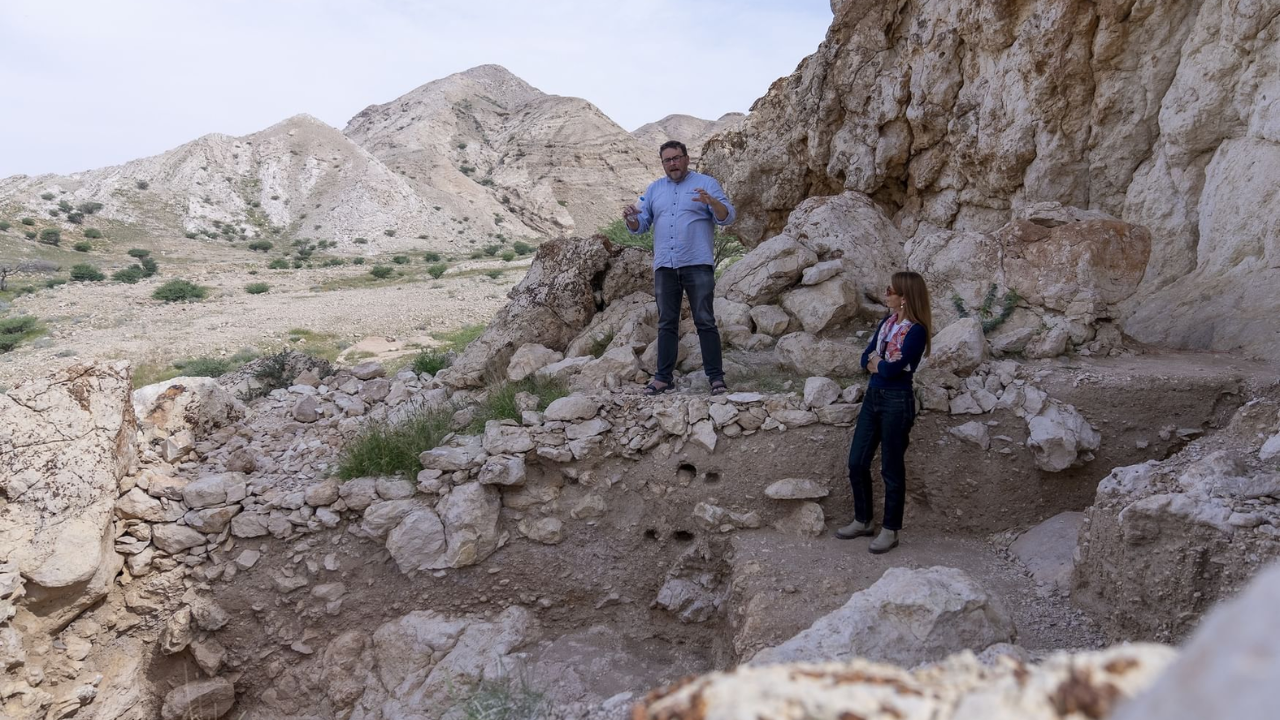
What the Sharjah Archaeology Authority and their international partners found at Buhais—a jagged limestone outcrop rising from the desert floor—were stone tools and hearth remnants that do not match the Neanderthal toolkits found in the Levant. Instead, these are the hallmarks of early Homo sapiens. The presence of these tools 125,000 years ago indicates that the Arabian Peninsula was not a barrier to be bypassed, but a destination in its own right.
This was a time of "Green Arabia." Earth’s orbital shifts triggered massive monsoon rains that pushed north, filling dry wadis with freshwater and turning the Rub' al Khali into a network of lakes and savannas. Humans didn't move because they were bold explorers; they moved because they were following the water and the game.
Reading the Stones
The technical analysis of the tools found at Buhais Rockshelter offers the most compelling evidence. These aren't the sophisticated, blade-like tools of the Upper Paleolithic. They are more primitive, yet specifically adapted for the environment of the time.
Archaeologists utilize Optically Stimulated Luminescence (OSL) to date these finds. This technology measures the last time mineral grains, such as quartz or feldspar, were exposed to sunlight. By testing the sediment layers directly surrounding the stone tools, researchers can pin down the exact window of habitation. At Buhais, the OSL dates consistently hit the 125,000-year mark.
This creates a massive problem for the old guard of archaeology. If humans were in Sharjah that early, why do genetic studies of modern populations suggest we all descend from a group that left Africa much later?
The answer is likely grim. These early migrations were probably "failed" expansions. These populations may have thrived for millennia during the green periods, only to be wiped out or forced back when the climate cycled back to extreme aridity. We are looking at the remnants of a lost pioneer generation that left no genetic trace in us today, but paved the geographical way for those who followed.
The Strategic Importance of the Jebel Buhais Site
Jebel Buhais is a geological anomaly that acted as a prehistoric magnet. Its height provided a vantage point to track animal migrations across the plains. Its limestone caves offered shelter from the sun. Most importantly, its geological structure trapped prehistoric rainfall, creating reliable springs.
Unlike sites in the interior of the Empty Quarter, which were swallowed by shifting dunes, the Rockshelter preserved distinct layers of history. This stratification allows scientists to see the "on-off" nature of human occupation. They see a layer of human activity, followed by a thick layer of sterile sand representing thousands of years of drought, followed by another layer of activity.
This pattern debunks the idea of a "seamless" expansion. It shows a species at the mercy of the environment, clinging to the fringes of habitable land.
Geopolitics and the New Archaeology
There is a broader context to why these finds are coming to light now. The United Arab Emirates has invested heavily in "Deep Time" research over the last decade. This isn't just about national pride; it’s about shifting the center of gravity in human origins research away from the Mediterranean and toward the Persian Gulf and the Indian Ocean rim.
For a long time, the Levant (modern-day Israel, Jordan, and Syria) was considered the only viable "northern route" out of Africa. The Buhais discovery validates the "southern route" theory. It proves that the Bab al-Mandab Strait was a viable crossing point much earlier than previously thought. This changes how we map the entire spread of humanity toward India and Australia.
The Problem with the Fossil Gap
While the stone tools are definitive, the lack of skeletal remains at Buhais remains a point of contention. In the acidic, shifting sands of the peninsula, bone dissolves quickly. Critics argue that without a skull or teeth, we cannot be 100% certain these tools weren't made by a different hominid species, such as Homo erectus or a late-surviving Homo heidelbergensis.
However, the specific "Levallois" knapping techniques found at the site are closely associated with early Homo sapiens assemblages in East Africa from the same era. The circumstantial evidence is overwhelming. We are looking at our direct ancestors' footprints, even if we haven't found their bones yet.
Environmental Determinism vs Human Agency
One of the most overlooked factors in the Sharjah discovery is the speed at which the environment changed. We often think of climate change as a modern phenomenon, but the 125,000-year-old residents of Buhais lived through radical shifts.
During the Eemian interglacial, the period associated with this find, global temperatures were actually warmer than they are today. Sea levels were higher. The "Green Arabia" these humans entered was a lush corridor. The fact that they disappeared from the site later is a stark reminder of how fragile human habitation is when the freshwater sources dry up.
The tools found aren't just artifacts; they are survival kits. They show a high degree of lithic flexibility. When the hunters at Buhais couldn't find the high-quality flint they were used to in Africa, they adapted, using local chert and limestone. This cognitive flexibility—the ability to look at a new landscape and rethink your entire survival strategy—is what truly defines the modern human.
The Implications for Future Research
The Buhais Rockshelter discovery has turned the Arabian Peninsula from a "void" on the map into a crucial laboratory for understanding human evolution. It forces us to reconsider other sites across Oman and Saudi Arabia that were previously dismissed as too young or too insignificant.
We are entering an era where the desert is being mapped with LiDAR (Light Detection and Ranging), revealing ancient riverbeds and paleolakes that are invisible to the naked eye. Each one of those dried-up lakes potentially hides another settlement like Buhais.
The story of human migration is no longer a straight line from Point A to Point B. It is a complex, overlapping map of starts and stops, of groups that ventured into the unknown and vanished, and of a landscape that was once a garden before it became a wasteland. Sharjah’s rocks have provided the evidence; now the rest of the map needs to be filled in.
The timeline has been shattered. The 60,000-year barrier is gone. We are looking at a history that is deeper, more chaotic, and far more interesting than we were led to believe. The humans at Buhais weren't just passing through; they were home.
Would you like me to analyze the specific types of stone tools found at Buhais to explain how they differ from those found in African sites?