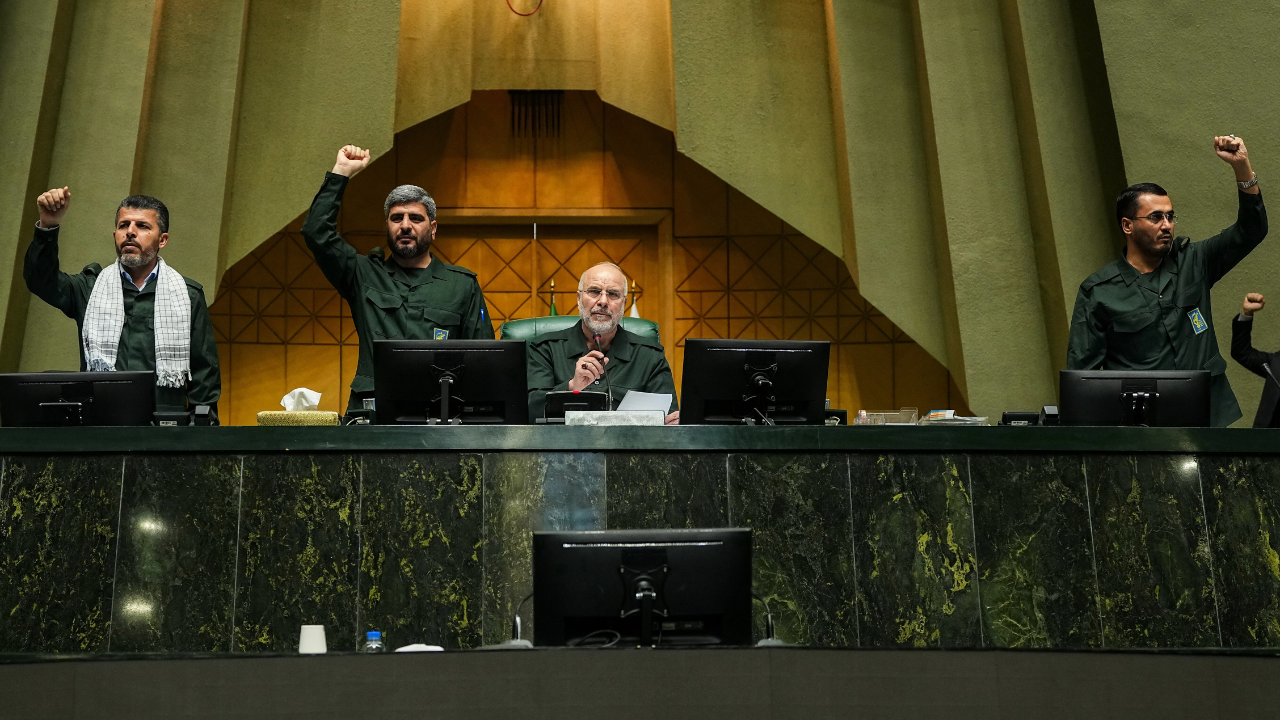
In the dimly lit hallways of Tehran’s Majlis, the air carries the scent of rosewater and heavy, industrial-grade anxiety. Mohammad Bagher Ghalibaf sits at the center of this storm, a man whose life has been a series of calculated maneuvers, from the cockpits of fighter jets to the mayor’s office of a sprawling, chaotic metropolis. He is a pragmatic survivor in a system that often devours its own. But today, the whispers surrounding him aren't just about domestic rivalries. They are about a phone call that may or may not have happened, and a bridge being built toward an unlikely architect in Washington.
The geopolitical chessboard is rarely about the pieces you see moving in the daylight. It is about the shadows they cast.
While the world watches the public posturing of "Maximum Pressure" and "Death to America," a different conversation is taking shape. It is a story of two men who understand the language of the deal better than the language of dogma. Donald Trump, back in the Oval Office, and Ghalibaf, the technocratic general who believes that a revolution that cannot feed its people is a revolution in name only.
The Pilot and the Property Mogul
To understand why Ghalibaf is the name currently circulating in high-stakes backchannels, you have to look at his hands. They are the hands of a pilot. In 2005, during his first run for the presidency, he didn't lean into the drab, grey suits of the traditional Iranian bureaucrat. He wore a pilot’s uniform. He wanted to signal something specific: precision, modernity, and the ability to navigate a vessel through turbulence.
Consider the hypothetical, yet grounded, perspective of a merchant in Tehran’s Grand Bazaar. Let's call him Arash. For Arash, the ideological purity of the ruling class doesn't pay for the rising cost of imported saffron or the plummeting value of the rial. He remembers Ghalibaf as the Mayor of Tehran—the man who built the tunnels, the highways, and the parks. Ghalibaf was the "doer." He was the man who made the city work, even if the methods were sometimes opaque.
For someone like Arash, and millions like him, the prospect of Ghalibaf leading a new era of engagement isn't about liking the United States. It’s about the exhaustion of poverty. When Donald Trump speaks of "making a deal" with Iran, he isn't looking for a scholar of Islamic jurisprudence. He is looking for a CEO. He is looking for someone who can sign a contract and make it stick.
The Invisible Bridge to Mar-a-Lago
The rumors didn't emerge from a vacuum. Reports have surfaced suggesting that Trump’s inner circle—those who value transactional diplomacy over ideological warfare—has identified Ghalibaf as the most viable interlocutor. The logic is cold and surgical. The hardliners are too rigid; the reformists are too weak. Ghalibaf, however, sits in the sweet spot of the "Principlist" camp. He has the military credentials to satisfy the Islamic Revolutionary Guard Corps (IRGC) and the technocratic streak to satisfy a starving economy.
But how does a man like Ghalibaf signal his readiness to a man like Trump?
It happens in the silences. It happens when Ghalibaf speaks of "smart governance" instead of "eternal struggle." It happens when he emphasizes that Iran’s missile program is a deterrent, a defensive shield, rather than a tool for expansion. To the American ear, this sounds like a starting bid.
Imagine the scene: a mid-level diplomat meets an intermediary in a quiet hotel in Muscat or Doha. No flags. No cameras. Just a folder containing a list of economic reliefs matched against nuclear concessions. This isn't the grand, sweeping idealism of the 2015 JCPOA. This is a gritty, street-level trade. Trump wants a win he can put on a billboard. Ghalibaf wants a win that puts bread on Arash’s table.
The Weight of the Turban and the Tie
The stakes are higher than any election cycle. Inside Iran, the Supreme Leader, Ayatollah Ali Khamenei, holds the ultimate keys. No move toward Washington happens without his silent nod. But the Leader is aging. The question of succession hangs over Tehran like a heavy fog. Ghalibaf isn't just auditioning for the presidency; he is positioning himself as the stabilizer for the transition that must eventually come.
The risk is immense. If Ghalibaf leans too far toward the West, he risks being branded a traitor by the ultra-hardliners who see any compromise as a stain on the martyrs. If he stays too distant, the economy will continue its slow-motion collapse, and the protests that have flickered across the country for years could turn into a conflagration he cannot control.
Negotiation is like weaving a carpet. One wrong thread, pulled too tight, can unravel months of labor. Ghalibaf knows this. He has survived the political purges of the last two decades by knowing exactly when to stay silent and when to strike.
The American Side of the Coin
On the other side of the Atlantic, the motivation is equally pragmatic. The American public is weary of "forever wars" and the tangled mess of Middle Eastern alliances. Trump’s base doesn't want another invasion; they want a total withdrawal that looks like a victory.
If Trump can claim he "tamed" Iran through the sheer force of his personality and a better deal, his legacy is secured. He doesn't need Iran to become a democracy. He doesn't need them to recognize Israel tomorrow. He needs them to stop the enrichment, stop the proxy attacks, and buy American products.
Ghalibaf speaks that language. He understands that in the world of the 21st century, power is often measured in barrels of oil and the strength of a currency rather than the fervor of a Friday prayer.
The Ghost of 1979
Yet, the ghost of the past always sits at the table. For the Americans, it is the trauma of the Hostage Crisis. For the Iranians, it is the memory of the 1953 coup. These aren't just history book entries; they are the scars that dictate the movements of every politician in both capitals.
When Ghalibaf looks across the ocean, he sees a volatile, unpredictable superpower. When Trump looks at Tehran, he sees a stubborn, ancient regime. The tragedy of the last forty years is that both sides have spent so much time shouting that they forgot how to listen.
But hunger is a powerful motivator. The Iranian people are tired. The middle class has been hollowed out. The youth, tech-savvy and globally connected, are looking at their counterparts in Dubai and Istanbul and wondering why they are the ones left behind. Ghalibaf knows that if he cannot provide a future for them, the system he serves will eventually crumble from within.
The Art of the Pivot
The transition from a military commander to a diplomat is never easy. It requires a shedding of the ego and an embrace of the compromise. Ghalibaf has spent his career preparing for this moment, even if he didn't know it at the time. He has been the policeman, the pilot, the mayor, and the speaker of the house. He is a man of many masks.
The question remains: which mask will he wear when the time comes to face the Americans?
The world of international relations often feels like a series of cold, mathematical equations. $X$ amount of uranium for $Y$ amount of sanctions relief. But the math doesn't account for the pride of a nation or the desperation of a father trying to buy medicine in a sanctioned market.
Ghalibaf is betting that he can bridge that gap. He is betting that Trump’s desire for a spectacle can be channeled into a functional peace. It is a gamble of breathtaking proportions. If he succeeds, he becomes the man who saved the Republic. If he fails, he will be remembered as just another footnote in a long history of missed opportunities.
The light in the Majlis is fading now. Outside, the traffic of Tehran hums with its usual, frantic energy. Millions of people are heading home, unaware that their fate may be resting on a series of whispered conversations between two men who couldn't be more different, yet are driven by the same singular desire: to win.
There are no certainties in the Middle East. Only the persistent, stubborn hope that someone, somewhere, is tired enough of the fighting to try something new. Ghalibaf is waiting. Trump is watching. The clock is ticking.
The chessboard is set, the pieces are moving, and for the first time in a generation, the players might actually be ready to talk. Not because they want to, but because they have run out of other options.
Would you like me to analyze the historical parallels between this potential deal and the 1972 opening to China?