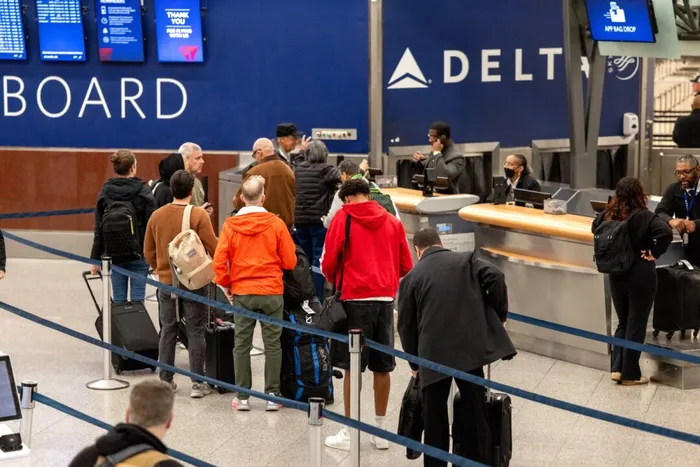
The coffee in Terminal 3 had gone cold three hours ago, but Elias held the paper cup like a talisman. Around him, the collective hum of O’Hare International Airport had shifted from the rhythmic pulse of commerce to a jagged, anxious static. It is a specific sound, unique to the American traveler: the frantic tapping of phone screens, the low murmur of apologies into headsets, and the occasional, sharp sob of a person who just realized they are going to miss a funeral, a wedding, or a first birth.
Outside the floor-to-ceiling glass, the world was vanishing. A relentless, horizontal sheet of white had erased the runways. The de-icing trucks looked like prehistoric beetles crawling through a void.
This wasn’t just a "weather event." It was a systemic seizure.
By noon, the number had ticked past 1,500. Not just 1,500 flights—1,500 vanished itineraries, 1,500 broken promises, and roughly 225,000 human beings suddenly untethered from their lives. When the FAA issues a ground stop, they aren't just pausing planes. They are suspending the delicate, invisible threads that hold our modern society together.
The Anatomy of a Standstill
We like to think of air travel as a triumph of physics. We focus on the thrust of the engines and the lift of the wings. But the true miracle of flight is logistical. It is a massive, multidimensional chess game played with aluminum pieces moving at five hundred miles per hour. When a major winter storm slams into a hub like Chicago, Denver, or New York, the board doesn't just get messy. It breaks.
Consider the "ferry flight" problem.
A plane sitting in sun-drenched Miami is scheduled to fly to Chicago, pick up passengers, and head to Seattle. If Chicago is buried under eight inches of heavy, wet snow, that plane stays in Miami. Suddenly, the people in Seattle—who have perfectly clear skies and no snow in sight—find their flight canceled. They look out the window at the blue firmament and feel cheated. They feel lied to.
The frustration stems from a fundamental misunderstanding of how we move. We are not traveling from Point A to Point B. We are participating in a global circulatory system. When a clot forms in the Midwest, the entire body feels the ischemia.
The Human Cost of the "Act of God"
For the airlines, a cancellation is a line item. It’s a calculation of crew timed-out hours, fuel burn saved, and rebooking software algorithms. For the passenger, it is a theft of time.
Take a hypothetical traveler named Sarah. She isn't a statistic. She is a surgical nurse who has worked twelve straight shifts to afford a four-day trip to see her daughter’s lead performance in a college play. She is standing at Gate B12, watching the "Delayed" sign flip to "Canceled."
There is no "next flight." The next flight is full. The one after that is also full because the 150 planes that didn't fly yesterday have created a backlog that will take four days to clear. Sarah’s four-day window just slammed shut. She won't see the play. She will spend the night on a carpet that smells of industrial cleaner and desperation, wrapped in a thin polyester blanket provided by an airline that legally owes her nothing because snow is an "uncontrollable circumstance."
This is the legal loophole that keeps the industry breathing during a crisis. Under current US Department of Transportation guidelines, airlines are generally required to refund your ticket if they cancel, but they aren't required to pay for your hotel, your meals, or the emotional wreckage of a missed milestone if the cause is weather-related. It is the ultimate "get out of jail free" card, played 1,500 times in a single afternoon.
The Invisible Infrastructure of Ice
Why can’t we just fly through it? We have satellites. We have GPS. We have de-icing fluid that costs five dollars a gallon.
The answer lies in the friction of reality.
When temperatures hover near freezing, the snow isn't light and fluffy. It is "mashed potato" snow. It is heavy, sticky, and lethal to aerodynamics. A layer of ice as thin as a piece of sandpaper can disrupt the airflow over a wing enough to reduce lift by 30 percent.
Then there is the ground crew. These are the people we never see—the ones working in sub-zero wind chills, hauling luggage, guiding planes with glowing wands, and operating the de-icing rigs. When the wind hits 50 miles per hour, it becomes physically dangerous for these humans to be on the tarmac. If the ground crew can't work, the planes can't move. If the planes can't move, the pilots "time out," hitting their federal safety limit for hours on duty.
Once a pilot times out, they are legally barred from flying. Even if the sun comes out ten minutes later, that plane is grounded until a fresh crew can be bussed in from a hotel—provided the roads aren't blocked by the same snow that stopped the planes.
The Ripple Effect
By evening, the 1,500 cancellations have birthed 4,000 delays.
The disruption cascades into the digital ether. Short-term rental hosts in distant cities see "no-show" notifications. Rental car counters at airports three states away sit idle because the people who reserved the SUVs are stuck in a terminal a thousand miles away. The economic hemorrhage is estimated in the hundreds of millions of dollars, but the true cost is the erosion of trust.
We have built a world that demands instant movement, yet we remain entirely subservient to the whims of a pressurized cold front moving down from the Rockies. We are high-tech nomads who can be humbled by a few billion crystals of frozen water.
There is a quiet dignity in the way people handle these moments, though. In the darkened terminals, strangers share power strips. A businessman gives his neck pillow to a child sleeping on a suitcase. In the absence of progress, we find a strange, stagnant community.
The Weight of the Wait
Elias eventually put his cold cup in the trash. He realized he wouldn't be making it home tonight. He called his wife, told her he loved her, and started the long walk toward the line for the "Customer Service" desk, which already snaked around the corner and into the next concourse.
He wasn't angry anymore. He was just tired.
As he stood in line, he looked back out the window. The snow was falling harder now, thick and silent, burying the multi-billion dollar infrastructure of the world's most advanced transportation network under a blanket of white indifference. The planes sat like ghost ships in the mist, their engines plugged and their cockpits dark.
We are masters of the sky until the sky decides we are not.
The lights of the terminal flickered, reflecting off the ice-crusted glass. Somewhere, a computer was already calculating the 1,501st cancellation. The machine doesn't feel the weight of the wait, but the floor of the airport was covered in people who did. They were huddled, waiting for a morning that promised nothing but a different kind of gray.
The silence of a grounded airport is the loudest sound in the world. It is the sound of a million plans turning into dust, settled softly on the wings of planes that aren't going anywhere.
Would you like me to analyze the current passenger rights regulations to see if you might be eligible for compensation during your next delay?