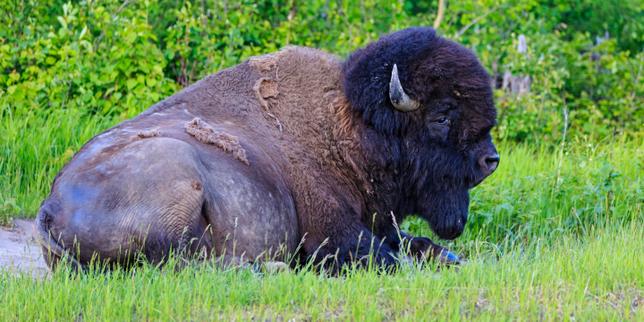
The grass does not merely grow in the Saskatchewan River Valley; it remembers. For over a century, that memory was a silent ache. The rolling fescue and the needle-and-thread grass swayed under the wind, waiting for a weight they hadn't felt since the 1800s. To the casual observer, the plains of central Canada were a serene, if empty, postcard of "wilderness." But to the Cree, the Saulteaux, and the Métis, the landscape was a crime scene.
A keystone was missing.
When the last of the wild bison were systematically slaughtered in the late 19th century—a calculated move to starve Indigenous populations into submission—the ecosystem didn't just change. It collapsed in slow motion. The birds lost their nesting materials. The soil lost its natural tillers. The people lost their brother.
Now, the silence is breaking.
The Ghost in the Tallgrass
If you stand on the edge of the Wanuskewin Heritage Park today, the air feels different. It carries a musk, a thickness that wasn't there five years ago. This isn't a zoo. This is a restoration of a broken clock.
Think of the bison, or paskwâwimostos in Cree, as the original engineers of the North American continent. They are not passive grazers like cattle, which tend to linger by water sources and turn the ground into a muddy slurry. Bison are restless. They are nomads by biological design. As they move, their massive hooves—carrying up to 2,000 pounds of muscle and bone—disturb the earth just enough to allow seeds to take root. They wallow, creating shallow depressions in the earth that catch rainwater, forming micro-wetlands for frogs and insects.
For decades, we tried to manage these lands with fences and chemistry. We treated the prairie like a crop to be harvested rather than a living lung. We were wrong.
The reintroduction of bison to Indigenous-led territories across Canada is a rejection of the idea that "nature" is something we look at through a glass window. It is a recognition that the land needs the animal, and the animal needs the people who never forgot its name.
A Discovery Carved in Stone
In 2020, something happened at Wanuskewin that moved the project from a scientific endeavor to something bordering on the miraculous. The bison, doing what bison do, were wallowing in the dirt. As they rubbed their heavy hides against the earth to shed their winter coats, they uncovered four rock petroglyphs and the very tool used to carve them.
These carvings had been buried for a thousand years.
The archaeologists hadn't found them. The ground-penetrating radar hadn't found them. The bison found them. It was as if the animals were literally digging up the history that had been buried alongside them. This wasn't a coincidence to the Elders on-site; it was a conversation. The bison were clearing away the dust of colonization to show the people that the contract between the two species was still valid.
The physical presence of the herd acts as a catalyst for a specific kind of ecological healing that humans simply cannot replicate. Their thick fur, shed in great clumps every spring, is the gold standard for bird nests. Species like the mountain plover and the thick-billed longspur rely on these patches of wool to keep their chicks warm against the brutal Canadian nights. Without the bison, the birds struggled. With them, the sky is getting louder again.
The Invisible Stakes of Sovereignty
To understand why this matters, you have to look past the majesty of the animal and toward the dinner table. For an Indigenous community, the return of the bison is the return of food sovereignty.
Dependence is a form of control. For over a century, remote communities have been tethered to expensive, low-quality grocery shipments—white flour, processed sugars, and meat that traveled thousands of miles in a refrigerated truck. This shift didn't just cause a health crisis; it caused a cultural amnesia.
When a community manages its own herd, the dynamic flips.
They are no longer "recipients" of a supply chain. They are stewards of a cycle. Harvesting a bison is a communal act that involves the Elders teaching the youth about anatomy, ethics, and the spiritual weight of taking a life to sustain another. It provides a lean, nutrient-dense protein that the human body in these latitudes evolved to process.
But the path isn't without friction. Modern Canada is a grid of highways, private property, and agricultural interests. You cannot simply "let the bison roam" in a world of barbed wire and high-speed rail. The tension lies in the negotiation between a 10,000-year-old migratory instinct and a 150-year-old legal system.
The Architecture of a Comeback
The logistics of returning a prehistoric giant to the land are daunting. You don't just open a gate. You have to build a relationship with the DNA of the herd.
Many of the bison being returned to Indigenous lands are descendants of the last wild herds that were saved by a handful of forward-thinking individuals in the late 1800s. Some come from Elk Island National Park, a genetic reservoir that has kept the lineages pure.
The process involves:
- Genetic Testing: Ensuring the animals aren't carrying cattle DNA, which was introduced through ill-fated crossbreeding experiments in the early 20th century.
- Cultural Protocol: Many releases begin with pipe ceremonies and songs, acknowledging the animal as a relative rather than a resource.
- Landscape Connectivity: Creating "corridors" that allow herds to move between protected areas without ending up on a highway.
It is a slow, methodical reconstruction. It is also a race against time. As climate change makes the Canadian prairies more prone to drought and extreme heat, the bison’s resilience becomes a survival strategy for the entire region. Unlike cattle, bison can survive on poor-quality forage and find water in places other animals can't. They are the climate insurance policy for the Great Plains.
Beyond the Horizon
There is a specific sound a bison makes when it is content. It’s a low, vibrational grunt that you feel in your chest more than you hear with your ears. It sounds like the earth itself is humming.
We often talk about "saving" species, as if we are the heroes of the story. But watching a calf take its first steps on the soil of its ancestors, protected by the very people who were nearly erased alongside it, suggests a different narrative. We aren't saving the bison. The bison are helping us find our way back to a version of ourselves that knows how to live on this land without breaking it.
The fence lines are still there, for now. The highways still cut through the valleys. But the memory in the grass is no longer an ache. It is a pulse.
The dust kicked up by the herd settles on the faces of the children watching from the ridges. They see a horizon that is no longer empty. They see a future that has four legs, a massive humped shoulder, and a gait that has outlasted empires.
The prairie is finally breathing again.