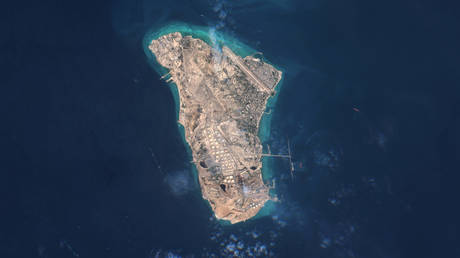
Kharg Island isn't a household name for most people, but it’s the undisputed jugular of the global energy market. When news broke that US forces struck military installations on this patch of land in the Persian Gulf, the immediate question wasn't just about "why," but about what happens to the gas prices at your local station. This isn't just another rocky outcrop. It’s the terminal that handles roughly 90% of Iran’s crude oil exports. If Kharg goes dark, the ripple effect doesn't just stay in the Middle East. It hits every major economy on the planet.
Most analysts focus on the military hardware—the surface-to-air missiles or the radar stations—but that’s only half the story. The real weight of Kharg Island lies in its infrastructure. It’s a massive, floating gas station for the world's most controversial oil. While the US might target military sites to send a message, the proximity of those targets to the oil jetties makes every strike a high-stakes gamble. You’re looking at a piece of land that serves as both a fortress and a piggy bank.
The Infrastructure That Keeps Iran Running
To understand why this island is a "red line," you have to look at the sheer scale of what’s built there. Kharg houses some of the largest oil storage tanks on earth. These aren't just bins; they’re strategic reserves that allow Iran to keep selling even when shipping is disrupted. The island features the T-jetty on its eastern side and the Sea Island on the west. These docks can accommodate VLCCs—Very Large Crude Carriers—which are basically floating skyscrapers.
When the US targets military sites on Kharg, they’re operating in an incredibly tight space. The island is only about 20 square kilometers. Imagine trying to hit a specific missile battery without accidentally sparking a fire at a facility that holds millions of barrels of crude. It’s a surgeon’s job in a middle of a brawl. If those terminals are damaged, Iran’s economy doesn't just stumble. It collapses. Since oil provides the vast majority of the regime's hard currency, losing Kharg is a literal existential threat to the government in Tehran.
Why the US Chose This Specific Target Now
The decision to strike Kharg isn't accidental. It’s a calculated move to show that nothing is off-limits. For years, there was a sort of "gentleman's agreement" that energy infrastructure was too dangerous to touch because of the global economic fallout. That's changing. By hitting military assets on the island, the US is signaling that the shield Iran thought it had—its role as an oil giant—is thinning.
But there’s a deeper layer here. Kharg is the nerve center for the Iranian Revolutionary Guard Corps (IRGC) naval operations in the northern Gulf. It’s not just about the oil. It’s about the speedboats, the mines, and the drones that can harass shipping in the Strait of Hormuz. By taking out radar or drone launch sites on the island, the US effectively blinds the eyes that watch the world's most important shipping lane. It's a move to regain "escalation dominance." If you can't see the tankers, you can't easily hijack them.
The Misconception About Oil Sanctions
A lot of people think sanctions already stopped Iranian oil. They didn't. Not even close. Iran has become a master at "ghost armadas"—tankers that turn off their transponders and swap oil at sea. Most of that oil starts its journey right there at Kharg. By striking the island, the US is moving past "paper" sanctions and into "kinetic" reality. It’s a shift from trying to stop the money to physically stopping the flow.
What This Means for Your Wallet
You’ll hear talking heads on financial news say the "market has priced in" Middle East tension. That’s usually nonsense. Markets price in what they know, not what they fear. The fear now is a direct hit on the Sea Island terminal. If that happens, you’re looking at a global supply shock of about 1.5 to 2 million barrels per day.
Even if the oil keeps flowing, the insurance rates for tankers in the Gulf skyrocket after a strike. Owners of these massive ships don't like sending $100 million assets into a zone where missiles are flying. Those costs get passed down. You see it at the pump. You see it in the price of plastic. You see it in shipping surcharges for your online orders. Kharg Island is the focal point where geopolitical posturing meets your monthly budget.
The Military Fortress Perspective
Aside from the oil, the island is a literal rock of ages for the Iranian military. It’s heavily fortified with S-300 or similar air defense systems. It’s got hardened bunkers and underground tunnels. During the Iran-Iraq war in the 1980s, Iraq tried to destroy Kharg hundreds of times. They failed. The island is resilient. It’s built to take a beating.
This history is why the current strikes are so significant. If modern US precision munitions are poking holes in defenses that survived a decade of total war in the 80s, it tells the Iranian leadership that their "unsinkable aircraft carrier" is actually quite vulnerable. It’s a psychological blow as much as a physical one.
The Environmental Disaster No One Is Talking About
There’s a massive risk here that gets ignored in the "war room" talk. The Persian Gulf is a shallow, enclosed body of water. An oil spill at Kharg, caused by a stray missile or a secondary explosion, would be an ecological catastrophe. It would take out desalination plants in neighboring countries like Kuwait or Saudi Arabia. Millions of people could lose their primary source of drinking water. This is why the US has to be so precise. A "win" that poisons the water supply of your allies isn't a win.
The Strategy Moving Forward
Don't expect this to be a one-off event. The tension around Kharg is a barometer for the entire region. If the strikes continue or move closer to the storage tanks, we're entering a new era of energy warfare. Iran has already threatened to close the Strait of Hormuz in retaliation. While they probably can't keep it closed for long, even a few days of chaos would send the global economy into a tailspin.
The smart move for anyone watching this is to stop looking at "conflict" as a vague term and start looking at specific nodes like Kharg. It’s the most important piece on the board.
If you’re tracking the impact, keep an eye on the "Brent Crude" spot price immediately following these reports. Watch for "Force Majeure" declarations from the National Iranian Oil Company. If those come out, the game has officially changed. You should also monitor the movement of the US 5th Fleet. Their positioning usually tells you if more strikes are coming or if they're moving into a defensive posture to protect the inevitable cleanup or shipping convoys. The situation is volatile, and the island of Kharg is right at the center of the storm.