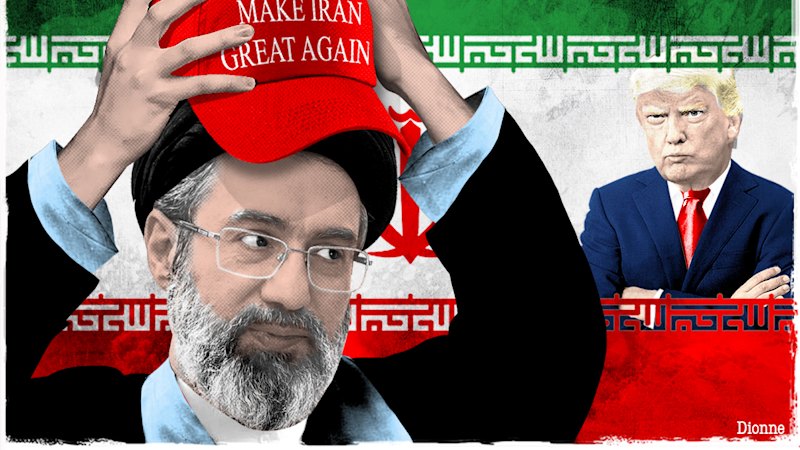
The smoke rising over Tehran following Operation Epic Fury was supposed to signal the end of a four-decade standoff. Instead, it has ignited a multi-front attrition trap that Washington is nowhere near winning. By March 2026, the decapitation of the Iranian leadership—specifically the killing of Supreme Leader Ali Khamenei on February 28—was intended to trigger a regime collapse or a desperate rush to the negotiating table. Neither happened. Instead, the United States has found itself entangled in a "hot" version of a cold war, where the adversary’s survival is its only necessary victory condition.
Iran is not fighting to win a conventional war; it is fighting to make the cost of American presence unbearable. This is the fundamental disconnect in the current administration's strategy. While the White House measures success in "obliterated" power grids and successful sorties, Tehran measures it in the price of a gallon of gas in Ohio and the depletion rate of million-dollar interceptor missiles against thousand-dollar drones.
The Decapitation Paradox
The logic behind the February strikes was simple. Remove the head, and the body will wither. Military planners calculated that a weakened Iranian economy and a population weary of clerical rule would seize the moment of Khamenei’s death to overthrow the Islamic Republic.
This was a catastrophic misreading of the IRGC (Islamic Revolutionary Guard Corps) and its institutional resilience. Rather than fracturing, the elite core of the Iranian military has coalesced around Mojtaba Khamenei. The succession, though fraught with internal tension, has been weaponized as a rallying cry for national defense. For a veteran analyst, the parallels to previous failed "regime change" philosophies are glaring. When an external power removes a central figure, the result is rarely a pro-Western democracy; it is a vacuum filled by the most radical, organized, and armed elements available.
The Resistance Economy Meets Total War
For years, Tehran has prepared for this exact scenario. Under the "Resistance Economy" doctrine, Iran shifted its dependencies away from Western markets long before the 2025 snapback sanctions were even a threat. By 2026, the capture of Venezuelan President Nicolás Maduro and the subsequent disruption of the "shadow fleet" were supposed to be the final blows.
They weren't.
Iran’s economic survival now hinges on a decentralized network of regional trade and grey-market oil exports that are nearly impossible to fully interdict without a total maritime blockade—a move that would trigger a global depression. The closure of the Strait of Hormuz has already proven this. With 21 miles of water serving as the world’s carotid artery, Iran doesn't need to defeat the U.S. Navy. It only needs to make insurance premiums for oil tankers so high that the global market chokes.
The Depletion Strategy
The most overlooked factor in this conflict is the math of attrition. During the twelve-day war in June 2025 and the subsequent 2026 strikes, Iran and its proxies launched waves of low-cost loitering munitions and ballistic missiles.
The exchange rate is devastatingly lopsided.
- Iranian Shahed-series drones: Estimated cost of $20,000 to $50,000.
- U.S. SM-6 or Patriot Interceptors: Estimated cost of $2 million to $4 million per shot.
In a prolonged conflict, the U.S. and its allies are trading limited, high-value technical assets for mass-produced, expendable Iranian hardware. Iran’s goal is to empty the magazines of regional missile defense systems. Once those interceptors are depleted, the "iron domes" over Riyadh, Abu Dhabi, and Tel Aviv become porous. The administration’s claim that Iranian forces have been "literally obliterated" ignores the fact that the IRGC’s most dangerous assets are hidden in "missile cities" deep underground, unaffected by surface-level bombardment.
The Regional Drift
The assumption that America’s regional partners would remain steadfast under fire has also been tested and found wanting. The March 2026 strikes on energy infrastructure in Saudi Arabia and the UAE sent a clear message: the U.S. umbrella cannot stop every raindrop.
We are seeing a quiet but significant diplomatic pivot. While publicly supporting the U.S. mission, several Gulf states have maintained back-channel communications with Tehran. They realize that while the U.S. can sail away, they have to live next to a vengeful Iran forever. The "unconditional surrender" demanded by the White House on March 6 is a political impossibility for a regime that views its struggle as a theological necessity.
The Nuclear Brinkmanship
Perhaps the most dangerous failure of the current strategy is the erosion of nuclear guardrails. With the JCPOA a distant memory and the 2025 diplomatic efforts in tatters, Iran has moved its enrichment facilities even deeper into the mountains.
The military strikes intended to set back the nuclear program have instead provided Tehran with the ultimate justification for a breakout. If the regime's survival is at stake, the "nuclear fatwa" against weapons of mass destruction becomes a luxury they can no longer afford. We are approaching a point where the only way to stop a nuclear Iran is a full-scale ground invasion—an option that no one in Washington, despite the tough talk, has the appetite or the manpower to execute.
The war is failing because it was built on the premise that Iran would behave like a rational corporate entity that folds when the costs exceed the profits. But the Islamic Republic is an ideological state designed for endurance. It has spent forty years practicing how to survive in the dark.
Turning the lights out in Tehran didn't make them surrender. It just made it harder for us to see what they're doing next.
The administration must now decide if it wants to continue chasing the ghost of a "total victory" that doesn't exist, or if it will acknowledge that the Middle East has changed in ways that cruise missiles cannot fix. The price of oil and the stability of the global economy are currently being dictated by a regime the U.S. claimed to have "obliterated" weeks ago. That isn't winning. It's a hostage situation.