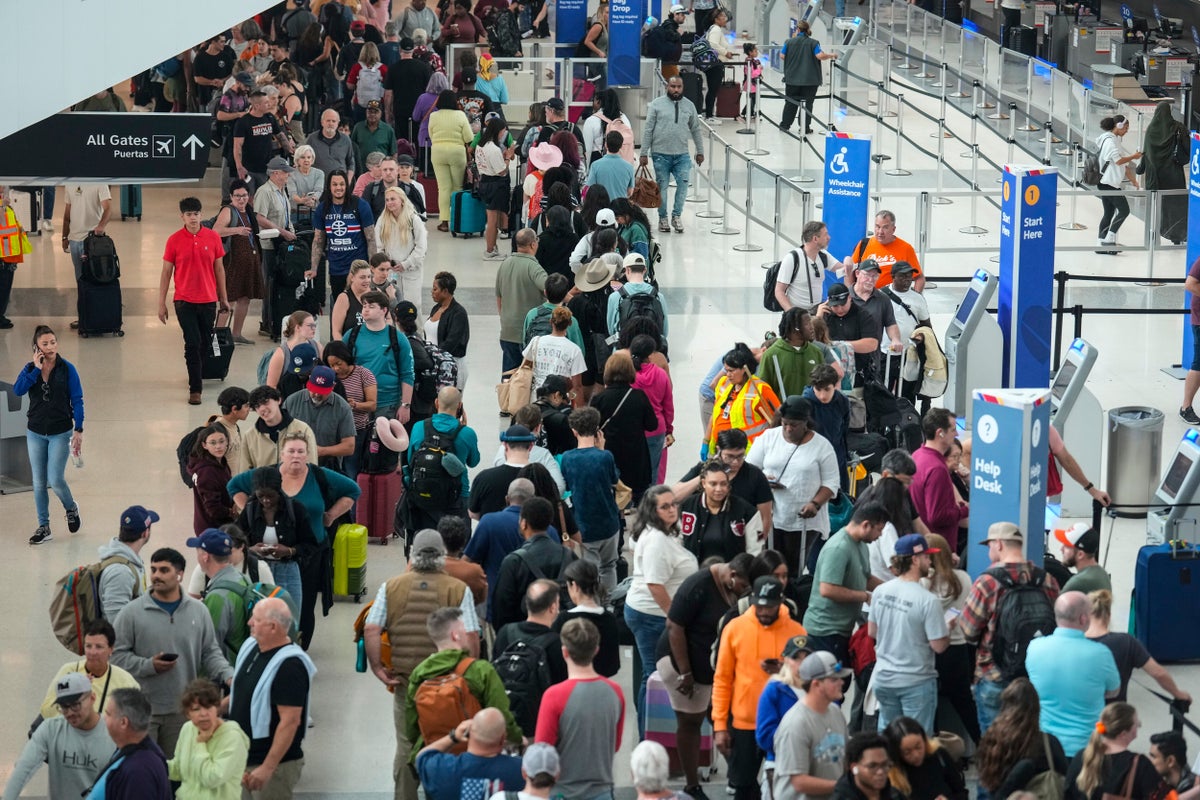
The coffee in Terminal 3 was still hot when the boards turned red.
Dubai International Airport does not do "quiet." It is a city that never sleeps, a pressurized lung of global commerce where an Emirates A380 touches down or lifts off every few minutes. The soundtrack is a constant, low-frequency hum of jet turbines and the polyglot murmur of twenty million travelers a year. Then, at a time when the desert sky was supposed to be filled with the blinking lights of descending giants, the humming stopped.
Ground stop.
The phrase sounds clinical on a news ticker. In the terminal, it feels like a physical blow. For Sarah, a hypothetical but representative traveler trying to reach London for a final goodbye to a parent, the red text on the Departures screen wasn't just data. It was a wall. Thousands of others stood beside her, clutching passports like talismans, watching the digital certainty of their lives dissolve.
The cause was a handful of plastic, lithium, and radio waves. Drones.
The Fragility of the Super-Hub
We have built a global civilization on the assumption of friction-less movement. Dubai is the crown jewel of that assumption. By connecting the West to the East through a single, hyper-efficient needle’s eye, Emirates turned a patch of sand into the world's crossroads. But that efficiency is also a vulnerability.
When an unauthorized drone enters the restricted airspace of a major international airport, physics takes a backseat to probability. A drone weighing only a few kilograms can, upon impact with a turbofan engine spinning at ten thousand revolutions per minute, cause a catastrophic failure. The math is brutal. Kinetic energy is calculated as $$E_k = \frac{1}{2}mv^2$$. When you factor in the closing speed of an aircraft, even a hobbyist’s toy becomes a kinetic missile.
Safety is not a suggestion in aviation. It is a binary. Either the sky is clear, or the fleet stays down.
On this night, the fleet stayed down. Emirates took the unprecedented step of canceling its entire departure schedule. The financial hemorrhage was immediate—millions of dollars per hour in fuel, re-booking costs, and lost productivity. Yet, the human cost was far more difficult to tally.
A City of Stranded Ghosts
By midnight, the terminal shifted from a transit hub to a makeshift refugee camp for the affluent and the desperate alike. Consider the logistics of a total shutdown. You cannot simply "pause" an airline that operates on a global rotation. Planes that were supposed to be in Sydney are stuck in Dubai. Crew members hit their legal flight-time limits while sitting on the tarmac. The delicate choreography of global logistics shattered.
In the gate areas, the silence was eerie.
People reacted in stages. First, the frantic tapping of smartphone screens. Then, the long lines at help desks that stretched toward the horizon of the duty-free shops. Finally, the resignation. Business travelers in three-piece suits slept on their carry-ons. Families with young children turned Patagonia jackets into makeshift pillows.
There is a specific kind of vulnerability that comes with being stranded in a foreign land, even one as luxurious as Dubai. You are caught in a legal limbo, a "sterile zone" between borders, waiting for a security threat that you cannot see to be cleared by authorities you will never meet.
The drones themselves were invisible to the passengers. They were ghosts on a radar screen, small blips that defied the authority of a multi-billion dollar infrastructure. It highlights a terrifying disparity in modern security: a thousand-dollar device can paralyze a trillion-dollar industry.
The Invisible War for the Sky
The technical challenge of stopping a drone at an airport is a nightmare of engineering and ethics. You cannot simply shoot them down over a crowded terminal. Jamming their radio frequencies can interfere with the very avionics the planes need to land safely. It is a game of electronic cat and mouse played in the frequencies between $2.4\text{ GHz}$ and $5.8\text{ GHz}$.
Security teams scrambled. While the public saw only the "Canceled" signs, behind the scenes, a high-stakes hunt was underway. Signal triangulators and long-range optics searched the darkness for the thermal signature of the intruders.
Why do people do it? Sometimes it is simple idiocy—a hobbyist wanting a "cool" shot of an Emirates tail fin. Other times, it is something more calculated. Regardless of the intent, the result is a total seizure of the world's most vital transport artery.
The industry calls this "asymmetric disruption." It is the ability of a small, low-cost actor to force a massive, high-cost entity into a defensive crouch. We are currently losing this battle. As drone technology becomes more autonomous and less dependent on easily jammed radio links, the "wall" around our airports becomes harder to maintain.
The Morning After the Silence
When the sun finally rose over the Hajar Mountains, the sky was officially declared clear. But the damage was done.
The recovery from a total ground stop takes days, not hours. It is a ripple effect. A flight canceled in Dubai means a missed connection in New York, which means a surgeon isn't there for an operation, or a deal isn't signed in Tokyo. We are so interconnected that a drone over a runway in the UAE vibrates through the entire skeleton of global trade.
Sarah eventually made it to London. She arrived twelve hours late. In the grand scheme of aviation statistics, she is a data point in a successful safety intervention. In the reality of her life, those twelve hours were a hole that could never be filled.
We live in an age of giants—giant planes, giant airports, giant corporations. We forget that these giants are held together by a fragile trust in the order of things. We trust that when we buy a ticket, the sky belongs to the professionals.
That night in Dubai, the world learned that the sky is more contested than we thought. As the first A380 finally roared down the runway, its engines screaming against the desert heat, the sound wasn't just a return to normalcy. It was an act of defiance against a small, buzzing shadow that had proved, for a few hours at least, that it could bring the world to a standstill.
The screens in Terminal 3 flickered back to green, the coffee shops brewed fresh pots, and the hum returned. But the travelers moving through the gates looked at the windows a little differently, searching the blue expanse for anything that didn't belong.
The giants were moving again, but they felt a little smaller than they had the day before.