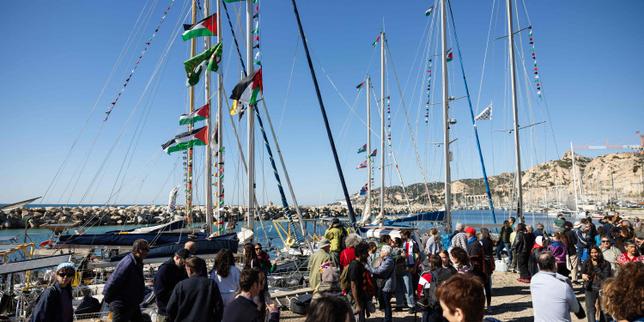
The departure of approximately twenty French vessels from the port of Marseille, bound for the Gaza Strip, represents more than a humanitarian gesture; it is a calculated attempt to disrupt a naval blockade through decentralized maritime logistics. This operation functions on a premise of high-stakes asymmetric signaling, where the primary objective is not the physical delivery of cargo—which remains constrained by the limited displacement of the participating civilian vessels—but the forced engagement of state-level naval assets. By examining the intersection of international maritime law, tactical naval positioning, and the logistical friction of the Mediterranean corridor, we can map the structural inevitabilities of this mission.
The Tri-Pillar Framework of Civil-Sovereign Confrontation
The Flotilla’s strategy rests on three specific operational pillars that define its potential for disruption:
- Legal Friction Generation: The mission relies on the tension between the "San Remo Manual on International Law Applicable to Armed Conflicts at Sea" and the "Right of Innocent Passage." By operating under civilian flags, the fleet forces the Israeli Navy to choose between allowing a breach of the blockade—thereby setting a legal precedent of non-enforcement—or executing an interdiction that incurs significant political costs.
- Visual Displacement Logistics: Unlike large-scale commercial shipping, a decentralized fleet of twenty smaller vessels creates a "swarm" effect. This complicates standard interception protocols. A single large vessel is easily boarded and diverted; twenty distinct targets require a synchronized multi-vector response, increasing the probability of operational errors or visual escalations that serve the organizers' communication strategy.
- The Supply Chain of Legitimacy: The cargo itself—often symbolic quantities of medical supplies or construction materials—acts as a moral ballast. The logistical efficiency of the delivery is secondary to the "intent of delivery." If the cargo is seized, the narrative shifts from a failed logistics mission to a forced deprivation, regardless of the actual tonnage involved.
Quantifying the Maritime Bottleneck
The journey from Marseille to the Eastern Mediterranean involves crossing approximately 1,500 to 1,800 nautical miles, depending on the specific route through the Strait of Bonifacio or south of Sardinia. The operational success of this transit is governed by a specific cost function:
$$C_{ops} = (V \cdot F) + (P_{i} \cdot D)$$
Where $V$ represents the number of vessels, $F$ the fuel and maintenance burn rate, $P_{i}$ the probability of interdiction, and $D$ the diplomatic or physical damage incurred during a confrontation.
The primary constraint for a fleet of this size is the "Refueling and Provisions Deadzone." Smaller civilian boats lack the range of naval destroyers. This creates a dependency on intermediate ports (likely in Greece or Cyprus). These ports become geopolitical chokepoints where diplomatic pressure can be applied to stall the mission before it ever reaches the Israeli-monitored "Exclusion Zone." The Israeli Navy typically maintains a multi-tiered defense perimeter:
- The Long-Range Detection Tier: Utilizing ELINT (Electronic Intelligence) and UAVs to track the fleet's AIS (Automatic Identification System) signals from the moment they exit French territorial waters.
- The Psychological Buffer: Radio warnings issued 50–100 nautical miles from the blockade line.
- The Kinetic Interdiction Zone: The final 20 nautical miles where physical boarding or "clogging" maneuvers occur.
The Mechanism of the Naval Blockade
To understand the challenge the French fleet faces, one must define the mechanics of the blockade itself. Israel’s naval blockade of Gaza is not merely a line in the water; it is a comprehensive maritime denial system. Under international law, a blockade must be effective to be legal. If Israel allows the French boats to pass, the legal status of the blockade is compromised, potentially opening the door for larger, more strategic shipments from state actors.
This creates a binary outcome for the Israeli Defense Forces (IDF). There is no "middle ground" in blockade enforcement. The logic of the IDF is centered on the prevention of "Dual-Use" technology transfer. While the French organizers emphasize humanitarian aid, the strategic reality is that the maritime corridor, once breached, is difficult to re-seal. Therefore, the interdiction is a preemptive strike against the erosion of sovereign control over the maritime border.
Resource Disparity and Tactical Asymmetry
The disparity in technical capabilities between the French civilian vessels and the Israeli Sa'ar 5 and Sa'ar 6-class corvettes is absolute. The civilian fleet operates with:
- Standard Marine Radar: Limited range and easily jammed.
- Commercial VHF Radio: Susceptible to localized interference.
- Steel or Fiberglass Hulls: Vulnerable to water cannons or low-level kinetic maneuvers.
Conversely, the blockading force utilizes advanced electronic warfare suites designed to disable vessel communications and propulsion without sinking the craft. The "Goal of Disruption" for the Flotilla is to force the IDF to use "Level 2" force (physical boarding) to generate the "Event" required for international media cycles. The IDF’s "Goal of Containment" is to use "Level 1" force (acoustic hailing, water displacement, or engine fouling) to turn the ships back without direct contact.
The Bottleneck of Port Infrastructure in Gaza
A critical analytical oversight in the competitor’s reporting is the state of the Gaza port itself. The port of Gaza is a shallow-water fishing wharf, not a deep-sea terminal. It lacks the draft depth for large cargo vessels and the crane infrastructure for containerized freight.
Even if the French boats were permitted to reach the shore, the offloading process would be a logistical nightmare involving:
- Lightering: Transferring goods from the boats to even smaller skiffs to reach the shallow docks.
- Manual Labor Triage: The absence of mechanized sorting means aid distribution would be delayed by days or weeks, undermining the "emergency" nature of the mission.
- Security Screening: Any goods entering Gaza must undergo screening for prohibited materials. A breach of the blockade bypasses the Kerem Shalom or Erez land crossings, where this screening occurs, creating a security vacuum that the Israeli government views as an existential risk.
Structural Risks and the Probability of Escalation
The mission faces a high probability of "Structural Fatigue." Sailing twenty disparate vessels in a coordinated formation over 1,500 miles requires a level of maritime discipline rarely found in activist-led operations.
- Mechanical Attrition: Statistically, 10–15% of the fleet will likely suffer engine failure or hull issues before reaching the Levant.
- Weather Contingencies: The Mediterranean in the spring is prone to sudden "Medicanes" or high-sea states that can scatter a civilian fleet, forcing them into the very ports (like Haifa or Ashdod) they are trying to avoid.
- The "First-Mover" Trap: If the lead vessel is intercepted, the remaining nineteen must decide between a coordinated "push" (increasing the risk of collision) or a staggered retreat. History shows that these fleets usually fragment under the pressure of professional naval maneuvers.
Strategic Forecast: The Shift from Sea to Screen
The Marseille-to-Gaza flotilla will not succeed in its stated goal of "breaking" the blockade in a physical or logistical sense. The tonnage of aid is negligible compared to the 100+ trucks required daily for basic sustenance in the enclave. Instead, the mission should be viewed as an exercise in Kinetic PR.
The endgame will likely occur 20–40 miles off the coast of Gaza. The Israeli Navy will implement a "Containment Box" maneuver, surrounding the fleet and disabling lead vessels using non-lethal electronic interference. The French government, while perhaps sympathetic to the humanitarian intent, is unlikely to provide naval escort for a civilian mission that explicitly intends to violate another state's declared blockade, as doing so would create a precedent that could be used against French maritime interests in other theaters (e.g., New Caledonia or the Caribbean).
The strategic play for the flotilla organizers is to sustain the "Confrontation Phase" for as many hours as possible to maximize global digital impressions. For the Israeli side, the play is "Maximum Speed, Minimum Visibility"—ending the encounter quickly and diverting the vessels to Ashdod port, where the aid can be processed through the standard, state-controlled land-based supply chains. The success of the mission will be measured not in kilograms of flour delivered, but in the duration and intensity of the digital transmission before the satellite uplinks are cut.