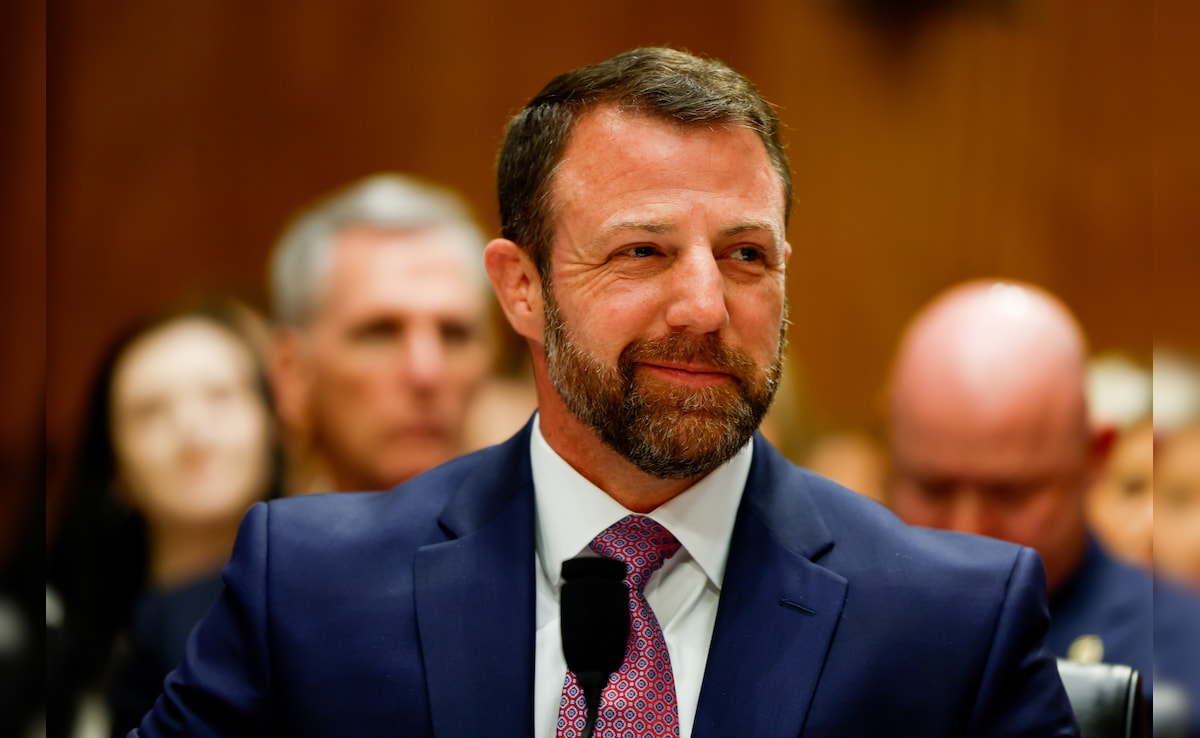
The United States Senate has officially handed the keys of the Department of Homeland Security (DHS) to Markwayne Mullin, a man who once famously offered to settle a political dispute with a cage fight. In a 54-45 vote on Monday, the former MMA fighter and plumber from Oklahoma became the ninth Secretary of Homeland Security. This was not a routine transition of power. It was an emergency extraction. Mullin arrives to find a department in total wreckage: a 38-day government shutdown that has left 100,000 employees working without pay, a TSA on the verge of collapse, and the smoking remains of Kristi Noem’s disastrously short tenure.
Mullin is now the second Native American in history to hold a secretarial Cabinet position, but he has no time for ceremony. He is stepping into a role defined by a double-edged sword. On one side, he must satisfy President Donald Trump’s demand for a massive, aggressive deportation machine. On the other, he has to end the legislative stalemate with Democrats who are furious over the recent killings of two U.S. citizens by federal agents in Minneapolis.
The Plumbing of Power
The story of Markwayne Mullin is often reduced to his 5-0 professional MMA record, but his real expertise lies in the unglamorous world of pipes and infrastructure. When his father fell ill, Mullin took over the family plumbing business at age 20 and grew it into a regional empire. This background is not just a colorful anecdote. It is the core of his political identity. He approaches government not as a theorist, but as a contractor who wants to fix a leak.
The leak at DHS is currently a flood. The department has been unfunded since February 14. At airports across the country, TSA wait times have skyrocketed as agents call out of work, unable to afford the gas to commute for a paycheck that isn't coming. Mullin’s primary mission is to "get the department off the front page." To do that, he has already begun a tactical retreat that would have been unthinkable under Noem.
During his confirmation hearings, Mullin made a significant concession to Senate Democrats. He pledged to end the use of administrative warrants—the paperwork ICE uses to enter homes and businesses without a judge’s signature. This was a direct rebuke of the standing administration policy. It was a calculated move to buy enough goodwill from Democrats like John Fetterman and Martin Heinrich, both of whom broke party lines to vote for him, to finally pass a funding bill.
The Noem Shadow
To understand why Mullin is here, one must look at the wreckage he is replacing. Kristi Noem’s exit was not a quiet resignation; it was an ousting fueled by a $220 million border security ad campaign that even Republicans called a waste of taxpayer money. Her tenure was defined by a refusal to negotiate and a public image battered by reports of an affair with a political aide.
Trump’s decision to move Noem to a "Special Envoy" role was a face-saving measure for an administration that realized its DHS leadership was actively preventing its own policy goals. Noem was a lightning rod for controversy. Mullin, despite his pugilistic reputation, is seen as a "pragmatic deal-maker" by those who served with him in the House. He is the "MAGA warrior" who knows when to stop punching and start talking.
The MMA Factor and the Temperament Question
The most vocal critic of Mullin’s appointment was not a Democrat, but Republican Senator Rand Paul. The two have a long-standing, visceral dislike for one another. Paul, who chairs the committee that oversees DHS, labeled Mullin a "man with anger issues" and the only Republican to vote against his confirmation.
Paul pointed to a 2023 incident where Mullin challenged Teamsters President Sean O’Brien to a physical fight during a hearing. "I just wonder if someone who applauds violence against their political opponents is the right person to lead an agency that has struggled to accept limits to the proper use of force," Paul said during the floor debate.
This temperament question is central to the DHS mission. The agency controls ICE, CBP, and the Secret Service—entities with the legal authority to use lethal force. After the Minneapolis shootings in January, where federal officers killed two American citizens during a protest, the demand for "steady leadership" is at an all-time high. Mullin’s challenge is to prove he can command 250,000 employees without letting his own competitive instincts lead to further escalation.
The Strategy of the Second Term
Mullin is a true believer in the "America First" agenda, but he is also a survivor of a decade in the House of Representatives. He knows that a department without a budget is a department without power. His early signals suggest a "gentler" version of the Trump immigration crackdown—not because he disagrees with the goals, but because he understands the logistics.
He has already signaled a willingness to restructure FEMA rather than eliminate it, a move that separates him from the more radical voices in the administration who view the disaster agency as a drain on resources. For Mullin, FEMA is a service business. If the pipes burst in a hurricane-prone state, you send the plumber.
The immediate test for the new Secretary is the "SAVE America Act." Trump has insisted that any DHS funding deal include this legislation, which would require proof of citizenship to vote. Democrats have called it a non-starter. Mullin is now the man in the middle. He must find a way to deliver a win for the White House while ensuring his employees can pay their mortgages.
A Department on the Brink
The reality of DHS in 2026 is one of exhaustion. The agency was born out of the 9/11 attacks as a massive, 22-agency conglomerate that has never truly integrated. Under the current administration, it has become the primary theater of the American culture war.
Mullin’s appointment is a bet that a self-made businessman with a fighter's heart can navigate a bureaucracy that has swallowed seasoned politicians whole. He is walking into a building where the morale is in the basement and the public trust is lower.
His goal of making the department "boring" again is ambitious. In an election year, with a president who thrives on border-related headlines, "boring" might be the one thing Markwayne Mullin isn't allowed to be. He has six months, by his own estimation, to prove that his brand of "pragmatic MAGA" can actually govern. If he fails, the shutdown won't just be a budget dispute; it will be the permanent state of American national security.
Would you like me to analyze the specific legislative hurdles Mullin faces with the SAVE America Act in the coming weeks?