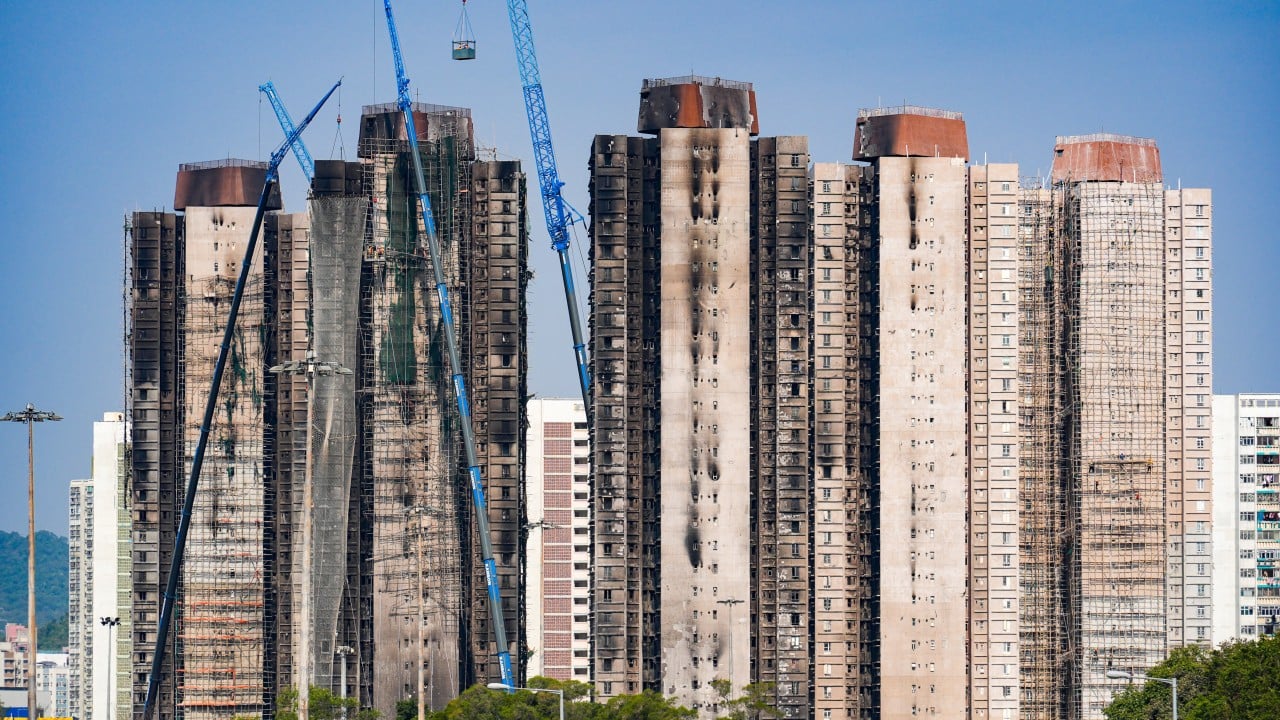
The petition by over 300 homeowners at Wang Fuk Court to Chief Executive John Lee is not merely a localized property dispute; it is a systemic signal of the breakdown in Hong Kong’s Home Ownership Scheme (HOS) maintenance and governance frameworks. The core issue rests on a fundamental disconnect between statutory responsibility and the economic reality of aging infrastructure. When the Hong Kong Housing Authority (HA) divests its interest in these estates, it transfers not just an asset, but a long-tail liability that many owners are financially and technically unequipped to manage.
The Maintenance Debt Trap
Wang Fuk Court, a subsidized housing estate in Tai Po, exemplifies the "maintenance debt" inherent in HOS estates built during the 1980s. This debt is the accumulated cost of deferred repairs and structural degradation that becomes due decades after the initial purchase. The current conflict centers on a $100 million renovation project, which represents a significant capital call on residents who often possess high equity in their homes but low liquid cash flow.
This situation creates a "Negative Equity of Utility." While the market value of the flat may remain high due to Hong Kong’s constrained supply, the cost to maintain its habitability is rising at a rate that outpaces the residents' savings. The petition to John Lee is an attempt to externalize these costs back to the government, arguing that the HA failed in its duty of care during the initial construction or subsequent handover.
Three Pillars of Governance Failure
The grievances of the Wang Fuk Court homeowners can be categorized into three structural failures:
- Informational Asymmetry: The owners' corporation (OC) often lacks the technical expertise to vet the necessity or pricing of large-scale engineering works. This creates a reliance on external consultants who may have misaligned incentives, leading to "gold-plated" renovation plans that exceed the actual structural requirements.
- Enforcement Gaps in the Building Management Ordinance (BMO): The BMO provides a framework for estate management but lacks a robust mechanism for dispute resolution when a significant minority (or in this case, a substantial petitioning group) believes the OC or the management company has acted against the collective interest.
- The Subsidized Housing Lifecycle Paradox: The HA sells these units at a discount to promote social stability. However, the discount is a one-time benefit, whereas the maintenance is a perpetual obligation. The government’s current stance—that the HA is no longer responsible once the "Defects Liability Period" has passed—ignores the long-term social cost of decaying HOS estates.
The Cost Function of Aging Estates
The financial burden on an HOS homeowner is not a flat line; it is an exponential curve. In the first 15 years, maintenance costs are negligible. Between years 20 and 40, the estate hits a "Critical Infrastructure Failure Zone."
- Vertical Transportation (Elevators): Systems reach end-of-life, requiring total replacement rather than piecemeal repair.
- Hydraulic and Fire Services: Metal fatigue and corrosion in piping lead to frequent leaks and non-compliance with modern safety codes.
- Building Envelope (External Walls): Concrete spalling and tile delamination pose third-party liability risks, forcing OCs into expensive scaffolding and re-rendering projects.
In the case of Wang Fuk Court, the $100 million figure is a byproduct of hitting all three of these triggers simultaneously. The homeowners' petition suggests that the HA should bear a "Legacy Liability" for these costs, a concept that the government has historically rejected to avoid setting a multi-billion dollar precedent across the entire HOS portfolio.
The Mechanism of Modern Slavery via Maintenance
The strategic bottleneck for the government is the risk of "forced displacement." If owners cannot pay the renovation levies, the OC has the legal power to register a charge against the property, which can eventually lead to foreclosure. This creates a political nightmare for the administration: a policy designed to create a "property-owning democracy" instead results in the eviction of the elderly and low-income due to technical maintenance requirements.
The petitioning residents are leveraging this political risk. By targeting John Lee directly, they are bypassing the Housing Bureau and the HA, framing the issue as a matter of social justice and administrative negligence rather than a simple contractual dispute.
The Failure of the Building Management Office (BMO) Reform
Recent attempts to update the BMO have focused on transparency and preventing bid-rigging in renovation contracts (the "Operation Building Bright" initiatives). While these are necessary, they do not address the "solvency gap." Even if a contract is fairly bid and transparently managed, the cost remains prohibitive for the demographic inhabiting these estates.
The "Operation Building Bright 2.0" subsidy scheme exists, but its criteria are often too narrow or the funding caps too low to cover the massive structural overhaul required at estates the size of Wang Fuk Court. This leaves a "Missing Middle" of estates that are too old to ignore but not dilapidated enough to qualify for total redevelopment.
Strategic Trajectories for Policy Adjustment
The Wang Fuk Court incident forces a reconsideration of the HOS exit strategy. The government has three viable paths, each with significant trade-offs:
- The Sinking Fund Mandate: Future HOS sales could require a mandatory, government-managed sinking fund, where a portion of the initial sale price and monthly fees are locked into a sovereign wealth-style fund for 30-year capital works. This would prevent the "capital call shock" currently facing Wang Fuk residents.
- The HA Buyback Option: In cases where maintenance exceeds a certain percentage of the building's replacement value, the HA could offer a buyback at a pre-determined formula, effectively converting the owners back into tenants and allowing the HA to perform the repairs as part of its public housing mandate.
- The Legislative Buffer: Amending the BMO to allow for "deferred payment schemes" against the property's eventual sale or inheritance. This would allow residents to stay in their homes without the immediate liquidity crisis, with the government or a state-backed bank financing the repairs and recouping the cost upon the next transfer of title.
The immediate challenge for the John Lee administration is to handle the Wang Fuk Court petition without triggering a "contagion of expectation." If the government provides a direct bailout for one estate, it must be prepared to do so for hundreds of others approaching the same 40-year threshold.
The tactical move for the administration is not a cash injection, but a technical intervention. A state-sanctioned independent audit of the $100 million renovation plan could identify "scope creep" or over-engineering. If the cost can be reduced by 20-30% through a more targeted "structural integrity only" approach, the political tension may dissipate without creating a fiscal black hole for the HA.
The homeowners must recognize that their equity is tied to the building's viability. A building that fails its mandatory inspection is a stranded asset. The standoff is therefore a game of chicken between the residents' liquidity and the building's physical reality. The government's role is to act as the "Technical Arbitrator" to ensure that the scope of work is lean, the financing is accessible, and the social contract of homeownership remains intact.
Establish a Permanent HOS Technical Advisory Board under the Housing Bureau. This board must have the statutory power to override OC decisions on renovation scope if they are found to be financially ruinous to the residents, while simultaneously providing low-interest "Life-Cycle Loans" to bridge the gap between resident savings and essential structural repairs. This moves the issue from a political crisis to a manageable financial engineering problem.