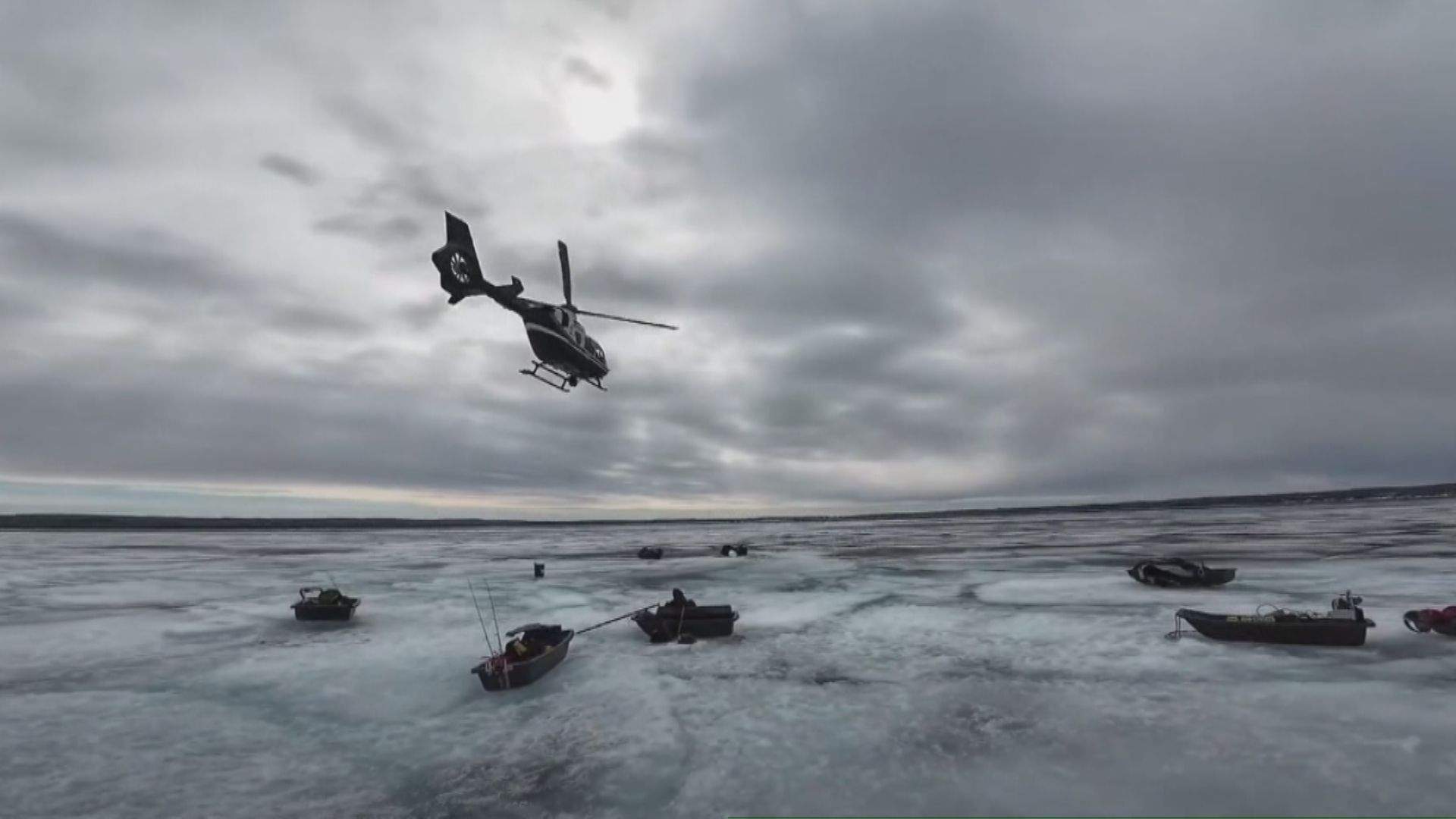
The headlines are predictable. Every time an ice floe breaks loose on Georgian Bay and a dozen anglers find themselves drifting toward the horizon, the pearl-clutching begins. The public demands a bill. They want the "irresponsible" to pay for the helicopter, the fuel, and the technician's overtime. We treat rescue costs as a moral tax on stupidity.
This reaction is intellectually lazy. It misses the fundamental point of public safety and the hidden value of high-risk recreation.
Charging for rescues doesn't make the ice safer. It makes it deadlier. When you attach a $15,000 price tag to a distress call, you aren't "encouraging personal responsibility." You are incentivizing a terrified person to wait two more hours before calling for help. In those two hours, the wind shifts, the body temperature drops, and a routine extraction turns into a body recovery. A dead angler costs the taxpayer significantly more in forensic investigation, legal processing, and lost economic output than a twenty-minute flight in a Griffon helicopter.
The Myth of the "Free" Rescue
The most common argument for billing rescued anglers is that they are "draining public resources." This assumes that if the rescue didn't happen, the money would stay in a vault somewhere.
It won't.
Search and Rescue (SAR) units—whether through the Canadian Coast Guard, the OPP, or the military—operate on fixed budgets. The pilots need flight hours to maintain proficiency. The technicians need real-world deployments to keep their skills sharp. If they aren't winching an angler off a chunk of ice in Georgian Bay, they are running drills over an empty field. The "cost" of the rescue is largely a sunk cost. The fuel is budgeted, the salaries are paid, and the equipment is depreciating whether it sits in a hangar or flies over the water.
By demanding a bill, the public is essentially asking to be charged twice: once through their taxes to maintain the capability, and again via a fine that serves no purpose other than spite.
Fear is a Terrible Safety Policy
Let’s look at the psychology of the "billable rescue." Imagine you are on a shelf of ice. You notice a crack. It’s six inches wide. You think you can jump it, but you're not sure. If you know that calling for help is free, you call now. The rescue is easy. The ice is stable. Everyone goes home for dinner.
Now, imagine you know that calling for help will result in a bill that wipes out your savings or gets you fired because of the "shame" of the public invoice. You don't call. You wait. You try to bridge the gap with a sled. You fall in. Now, instead of a simple landing and pickup, the state has to launch a multi-agency recovery operation involving divers and specialized equipment.
The "cost-recovery" model is a blood-soaked strategy. In jurisdictions that have experimented with charging for SAR—certain counties in the U.S. or specific Alpine regions—the result isn't fewer rescues; it's more complicated, more dangerous, and more expensive rescues.
The Economic Engine of "Irresponsibility"
We love to hate the guy on the ice, but we love the money he brings to the Great Lakes. High-risk outdoor tourism is a massive driver for rural economies. The people buying $80,000 trucks, $15,000 snowmobiles, and thousands of dollars in gear are the same people we want to "punish" when nature wins a round.
If you make Georgian Bay a "pay-to-play" zone for safety, you kill the brand. Outdoor enthusiasts will take their disposable income to jurisdictions that understand the social contract: the state provides a safety net, and the citizens provide the tax base through consumption and commerce.
We should stop viewing SAR as a luxury service for the reckless and start viewing it as critical infrastructure, no different than a fire department or a highway patrol. We don't bill the driver who skids on black ice for the cost of the ambulance. We don't bill the homeowner who left a candle burning for the water used to put out the fire. Why do we treat the water differently?
The Social Contract of the Wild
There is a deeper, more philosophical issue at play. A society that punishes its citizens for interacting with the natural world is a society in decline. We are already suffering from a catastrophic retreat into climate-controlled bubbles. When we scream for anglers to be fined, we are really saying, "Stay inside. Stay safe. Be a passive consumer."
I have spent decades watching how people interact with risk. The people on that ice shelf aren't "morons." They are people participating in a tradition that predates the invention of the suburbs. They understand that $180^{\circ}$ shifts in wind direction can turn a solid floor into a raft. They accept the risk. The state should accept the role of the protector without the petulant need to send a bill.
The Real Solution Nobody Wants to Hear
If you actually want to reduce rescue costs, you don't send bills. You do three things that actually work:
- Investment in Real-Time Sensor Arrays: Instead of waiting for a 911 call, we should be using $Sat-Link$ data and local acoustic sensors to monitor ice movement. If the shelf starts to move, automated alerts go to every cell phone in a five-mile radius. Prevention is cheaper than a flight.
- Infrastructure, Not Invoices: Build better, more accessible shore-based safety points. If there are known "hotspots" for ice breaks, stationing seasonal assets closer to those points reduces transit time and fuel burn.
- End the Public Shaming: The "Wall of Shame" approach to rescue news discourages people from sharing information about dangerous conditions. When a rescued angler is treated like a criminal, they don't tell their buddies how they got trapped. They go silent. We lose the data. We lose the lesson.
The Cost of Cowardice
The push to bill for rescues is driven by a specific type of modern cowardice—the desire to live in a world where "consequences" are always financial and always someone else's problem. It is the height of arrogance to suggest that because you don't go on the ice, you shouldn't have to support the system that saves those who do.
The beauty of a public search and rescue system is its universality. It exists for the child who wanders away from a campsite, the hiker who twists an ankle, and yes, the angler who gets caught on a drifting floe. Once you start means-testing "worthiness" for rescue, you have abandoned the principle of public safety entirely.
Who decides who is "stupid" enough to pay?
- Is it the hiker without a map?
- The swimmer who ignored a red flag?
- The driver who didn't check their tire pressure?
The moment you introduce a bill, you introduce a bureaucrat into a life-or-death decision. That is a trade-off we should never be willing to make.
The next time you see a helicopter hovering over Georgian Bay, don't reach for a calculator. Be grateful you live in a country that still values human life more than the price of aviation fuel. Stop trying to tax the spirit of adventure out of the population.
Stop crying about the bill and let the rescuers do their jobs.
Would you like me to analyze the specific budgetary breakdown of a Coast Guard SAR operation to show where the money actually goes?