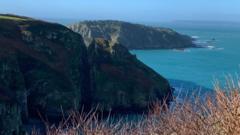
The smallest self-governing entity in the British Isles is currently staring at a ledger that does not balance, and the cost of maintaining a 16th-century dream in a 21st-century economy has finally come due. For decades, Sark has been the ultimate jurisdictional outlier—a car-free, dark-sky sanctuary where the feudal shadow of Elizabeth I’s 1565 charter still looms over the jagged cliffs. But as of March 2026, the rhetoric of "independence" is being replaced by the cold reality of "solvency." A newly established Bailiwick Commission, led by heavyweights like Sir Robert Neill, is now dissecting the island’s constitutional and economic DNA to determine if this micro-state can actually survive without being absorbed by its larger neighbor, Guernsey.
The primary crisis is simple to state but nearly impossible to solve under current laws. Sark is running out of money, and its infrastructure is quite literally falling into the sea. From the stabilization of the La Coupée land bridge to a looming £2.5 million loan required just to keep the lights on, the island’s government, Chief Pleas, is finding that a population of 500 people cannot support the high-tech, high-cost requirements of a modern state.
The Electricity Trap
The most immediate threat to Sark’s autonomy isn't a foreign invader, but a power grid. For years, the relationship between the government and Sark Electricity Limited (SEL) has been a saga of litigation and escalating tariffs. Now, Chief Pleas is moving to nationalize the service, backed by a loan from the States of Guernsey. On the surface, it looks like a rescue. In reality, it is a debt trap.
To secure this funding, Sark has had to pledge its future alcohol tax revenue as collateral. For an island that prides itself on being a "fiefdom," this is a profound humiliation. It is the first step toward what many residents fear is "debt servitude." If Sark cannot service this debt, Guernsey—which is already funding the lion's share of the £500,000 Bailiwick Commission—will have every right to demand more than just interest. They will demand a say in how Sark is run.
The numbers are brutal. In a community where many live paycheck to paycheck, the idea of 500 residents servicing a multi-million pound debt is a mathematical fantasy. Either the population must double, or the tax system must be dismantled and rebuilt from the ground up.
The Death of the Forfait
For generations, Sark’s "Personal Capital Tax" has been the envy of the offshore world. It was a system built for a simpler time: you paid a "forfait" based on the size of your property rather than the depth of your pockets. It allowed the ultra-wealthy to live alongside fishermen while paying essentially the same nominal fee to the state.
That era is over. Under intense pressure from Guernsey to "professionalize" its finances, Sark is currently debating a shift toward a banded wealth tax. This would charge residents based on their global assets. It is a move intended to tap into the deep reserves of the island's "hidden" millionaires, but it risks triggering an exodus.
The irony is thick. Sark needs the wealthy to stay to pay for the new sewage systems and harbor repairs, but the very act of asking them to pay more threatens the "tax-free" allure that brought them there in the first place. If the employers and investors leave, the island is left with an aging population and a mounting bill for healthcare and education that it cannot possibly meet.
The Population Paradox
Sark is currently an island of 500 people with an average age approaching 60. You cannot run a country on a volunteer basis when the volunteers are too old to climb the ladders. The "Future Sark" initiative, which has recently come under fire for duplicating work already done by the King’s Foundation, aims to double the population to 1,000.
But where will they live? Until 2021, land in Sark was governed by a 1611 decree that prevented tenements from being subdivided or mortgaged. While the Land Reform Law finally allowed for mortgages and the breaking up of ancient plots, the housing stock remains static and expensive.
Infrastructure at the Breaking Point
- Connectivity: 5G is slated for a 2026 rollout, a desperate attempt to attract digital nomads who can work from anywhere.
- The Harbor: The lifeline of the island requires massive capital investment that the current budget (roughly £2.2 million) cannot cover.
- Healthcare: The cost of medevacs and resident doctors is spiraling, leading to talk of a "community-funded" model that looks suspiciously like the socialized systems the island once shunned.
A Sovereignty for Sale
The Bailiwick Commission is tasked with reviewing the "constitutional relationship" between the islands. In diplomatic speak, this means finding a way for Guernsey to provide the services Sark needs without technically annexing it. But true independence requires financial self-sufficiency.
Sark’s current path is one of managed decline. It is attempting to maintain the trappings of a 16th-century fiefdom while begging for 21st-century bailouts. The residents are divided, more so now than during the infamous era of the Barclay brothers' interventions. Some argue for a "return to basics," ignoring the fact that a "basic" life in 2026 still requires high-speed data, modern medicine, and a reliable power grid.
The coming months will decide if Sark remains a sovereign anomaly or becomes a picturesque ward of the States of Guernsey. If the island cannot find a way to monetize its "brand"—perhaps through the proposed Marine Protected Area or eco-tourism—the ledger will eventually force a conclusion that the politicians are too afraid to voice.
Would you like me to analyze the specific debt-to-GDP projections for Sark under the proposed 2026 wealth tax bands?**