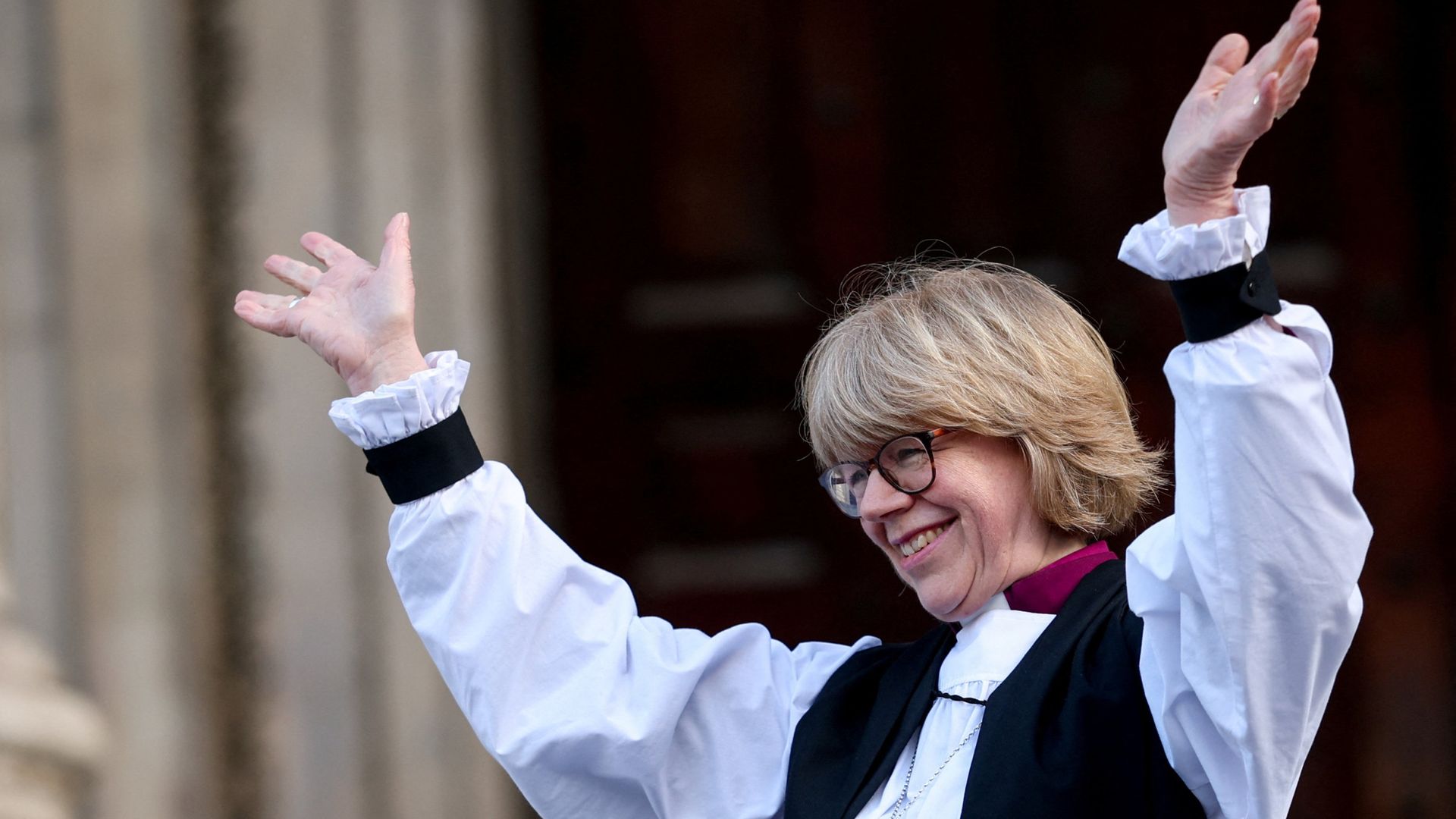
The enthronement of the first female Archbishop of Canterbury is not merely a milestone for the Church of England. It is a structural detonation. After centuries of male-only leadership, the arrival of a woman at the pinnacle of the Anglican Communion marks the final collapse of a long-standing internal truce. This shift represents the ultimate victory for the liberal wing of the Mother Church, but it simultaneously threatens to sever the already fraying threads that bind the global Anglican provinces together.
To understand the weight of this moment, one must look past the colorful vestments and the historic photo opportunities. The Archbishop of Canterbury occupies a unique position. They are the "First Among Equals" (Primus inter Pares) for over 85 million Christians worldwide. Yet, the power of the office has always relied on a delicate, almost impossible balance of tradition and adaptation. By seating a woman in the Chair of St. Augustine, the Church has chosen a side in a theological war that has been simmering since the first women were ordained as priests in 1994.
The Theological Fault Lines
The transition from male to female leadership in Canterbury isn't a simple HR update. Within Anglicanism, the "Global South"—comprising massive, growing congregations in Africa, Asia, and Latin America—views this move as a departure from biblical orthodoxy. These provinces often hold a complementarian view of leadership or adhere to traditional interpretations that reserve the highest episcopal offices for men.
For decades, the Church of England attempted to maintain unity through "ordered liberty," a polite way of saying they agreed to disagree. But the Archbishop is the symbol of unity. When that symbol changes fundamentally, the theological compromise that held the Communion together vanishes. We are seeing the emergence of a two-tier Anglicanism. On one side sits the Western, liberalizing core; on the other, a conservative, rapidly expanding majority that increasingly views Canterbury as a spiritual outlier rather than a guiding light.
Power Shifts and the GAFCON Rebellion
The investigative reality is that the office of the Archbishop has been losing its global grip for years. The Global Anglican Future Conference (GAFCON) and the Global South Fellowship of Anglican Churches (GSFA) have already declared they no longer recognize the Archbishop of Canterbury as their leader following previous disputes over same-sex blessings.
The enthronement of a female Archbishop provides the final, concrete justification for these groups to formalize a parallel structure. This isn't just about gender. It is about authority. Who decides what the Church believes? Is it the historic see of Canterbury, or is it a consensus of the global faithful? By moving forward with this enthronement, the Church of England is effectively acknowledging that it prefers ideological consistency over global institutional unity.
The Internal Resistance
Even within the borders of the United Kingdom, the transition is far from smooth. The Church of England operates under a "Five Guiding Principles" framework, which was established to ensure that those who cannot in good conscience accept the ministry of women still have a place in the Church.
- Provincial Episcopal Visitors: Often called "flying bishops," these men provide oversight to parishes that reject female leadership.
- Alternative Oversight: Parishes can legally request a male bishop to perform confirmations and ordinations.
The existence of a female Archbishop creates a logistical and spiritual paradox. How can the supreme head of the clergy be someone whose sacramental authority is rejected by a significant minority of her own priests? This isn't a theoretical problem. It creates a vacuum of leadership. If a portion of the clergy views the Archbishop’s very presence as a breach of apostolic tradition, her ability to command, discipline, or inspire is crippled from the outset.
The Political Pressure and the Crown
The Church of England is the established church. The King is the Supreme Governor. This means that the appointment of an Archbishop is as much a political act as a religious one. In the years leading up to this appointment, the pressure from Westminster to "modernize" was immense. Members of Parliament have frequently hinted that the Church’s unique legal status—including its 26 guaranteed seats in the House of Lords—is contingent on it reflecting the values of modern British society.
The investigative trail shows a Church caught between two masters. To satisfy the British State and the secular public, it must embrace progressive social shifts. To maintain its spiritual heritage and global ties, it must remain anchored in tradition. The selection of a woman suggests that the fear of losing domestic relevance outweighed the fear of a global schism.
Economic and Demographic Realities
Numbers tell a story that press releases ignore. Attendance in the Church of England has been in a steady, decades-long decline. The average age of a congregant is rising, and the vast estates of the Church—thousands of historic buildings—are a massive financial liability.
The strategy behind a "historic" appointment like this is often aimed at optics. It is an attempt to signal to a younger, more secular generation that the Church is "with the times." However, data from other denominations, such as the Episcopal Church in the United States, suggests that rapid liberalization does not necessarily reverse decline. In many cases, it accelerates it by alienating the most committed, traditional donors and members without successfully attracting a secular audience that has long since checked out of organized religion.
The Shadow of the Previous Occupants
The outgoing Archbishop left a legacy of attempted mediation that ultimately satisfied no one. By trying to keep everyone under the same tent, the office became a target for criticism from both the left and the right. The new Archbishop does not have the luxury of mediation. Her existence in the role is, in itself, a definitive statement.
She inherits a bureaucracy that is bloated and a clergy that is exhausted. The "unimaginable" moment described by the media is, for those inside the system, a moment of profound anxiety. They are wondering if the roof will hold. The clerical structures that supported the Archbishop for five centuries were built on the assumption of a specific type of continuity. That continuity is now broken.
A New Form of Governance
We should expect to see the new Archbishop move quickly to consolidate power within the "house of bishops" while potentially ignoring the more vocal critics in the General Synod. To survive, the office will likely pivot away from being a global arbiter and focus instead on becoming a domestic social actor. Expect more involvement in poverty advocacy, climate change initiatives, and housing reform. These are "safe" areas where a female Archbishop can build a profile that resonates with the British public, bypassing the thorny theological debates that she cannot win.
The global provinces will respond by accelerating the "reset" of the Anglican Communion. We are moving toward a "federated" model. In this scenario, Canterbury remains a historic site of pilgrimage and a symbolic head, but it loses any real influence over the doctrine or practice of churches in Nairobi, Lagos, or Sydney. The "Mother Church" is becoming a lonely parent in an empty house.
The Liturgical Conflict
Beyond the politics, there is the matter of the liturgy itself. The Archbishop of Canterbury is the lead celebrant at the most significant state occasions. Her presence at the altar changes the visual and "felt" theology of the state. For some, this is a long-overdue correction of a patriarchal error. For others, it is the moment the Church of England ceased to be part of the "One, Holy, Catholic, and Apostolic Church" and became a local religious NGO.
The sheer scale of the change cannot be overstated. It is the most significant shift in the English Church since the Reformation. While the Reformation was a break from Rome, this is a break from a universal consensus on the nature of the priesthood that had remained largely intact for 2,000 years.
The celebration in the aisles of Canterbury Cathedral will be loud. The incense will be thick, and the music will be sublime. But outside those walls, the cracks in the foundation are widening. The new Archbishop takes her seat not at the head of a unified global force, but as the overseer of a managed retreat. The "unimaginable" has become reality, and now the Church must live with the consequences of its choice.
A church that attempts to be everything to everyone eventually becomes nothing to anyone. The coming years will reveal whether this appointment is a genuine rebirth or the final, elegant act of a dying institution. The wait for the first female Archbishop is over; the fight for the soul of Anglicanism has only just begun.