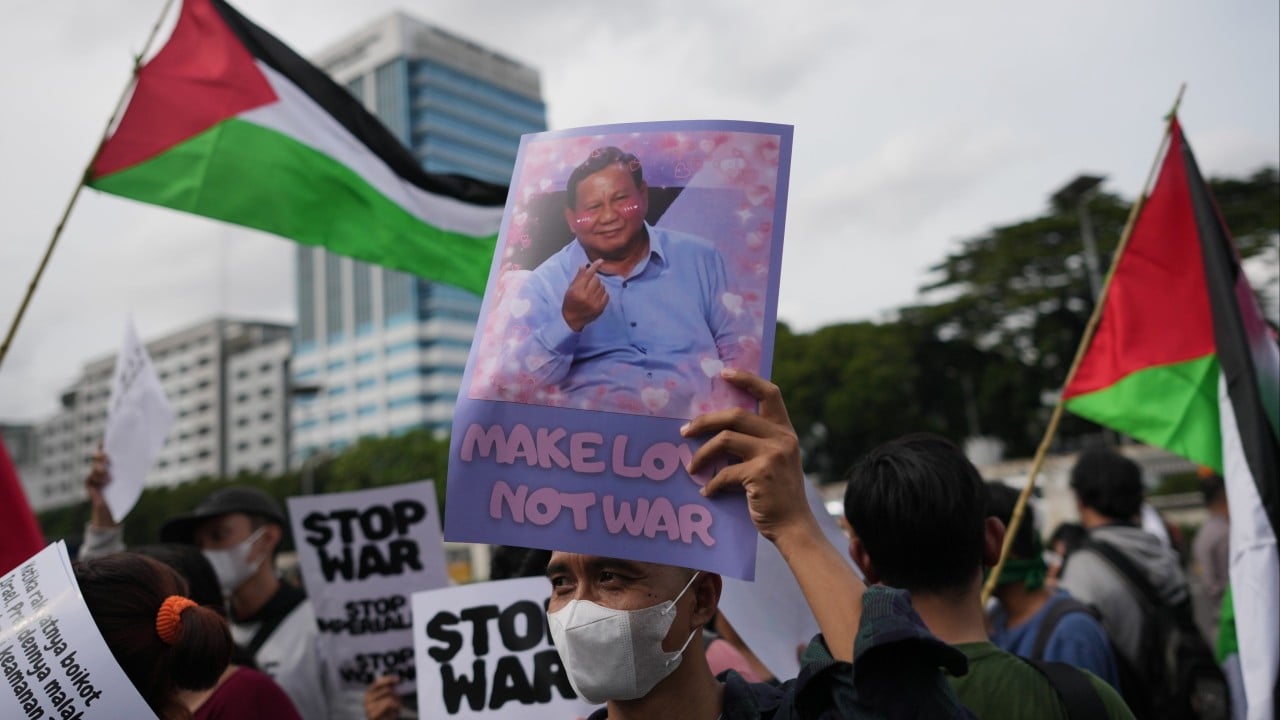
The recent diplomatic assertions by Indonesian President-elect Prabowo Subianto regarding Middle Eastern instability and the efficacy of Western military intervention represent more than a localized political opinion; they signal a rigid adherence to the doctrine of "Active and Independent" foreign policy at a time of global systemic fragmentation. When Prabowo expresses "surprise" at the scale of conflict or dismisses the utility of aerial bombardment in achieving regime change, he is applying a specific historical framework—rooted in Indonesia's own decolonization and internal stability struggles—to the contemporary Levant and Persian Gulf. This perspective challenges the prevailing Western liberal interventionist logic by prioritizing Westphalian sovereignty over ideological alignment, suggesting that the cost-benefit analysis of kinetic military action is fundamentally flawed if it ignores the socio-political resilience of the target state.
The Mechanics of Sovereignty and the Failure of Kinetic Regime Change
The assertion that foreign military intervention, specifically US-led bombing campaigns, fails to trigger regime change is supported by a structural analysis of state resilience. In political science, the "Rally 'Round the Flag" effect describes a measurable increase in domestic support for a government during periods of international crisis or foreign attack. Prabowo’s skepticism aligns with the historical observation that external pressure often incentivizes a ruling elite to consolidate power rather than fragment.
The failure of kinetic intervention to achieve political restructuring can be broken down into three distinct bottlenecks:
- The Legitimacy Deficit: When a change in leadership is perceived as an external imposition, the successor government lacks the organic grassroots support required to maintain order without perpetual foreign subsidization.
- Institutional Deepening: Targeted states often possess "deep state" structures—military, intelligence, and paramilitary networks—that operate independently of the visible executive. Bombing campaigns rarely neutralize these subterranean layers, which eventually re-emerge to fill power vacuums.
- Information Asymmetry: Intervening powers frequently miscalculate the threshold of civilian endurance. In many post-colonial or authoritarian contexts, the population’s "pain tolerance" for economic and physical hardship exceeds the political patience of the intervening democracy’s electorate.
Indonesia’s own history of resisting external meddling during the 1945-1949 National Revolution informs this worldview. The strategic takeaway is that political transitions are only durable when they are internally driven and externally recognized, rather than externally forced.
Indonesia’s Strategic Neutrality as a Risk Management Tool
Prabowo’s public surprise regarding the Iran-Israel escalation functions as a tactical "buffer" in Indonesia’s bilateral relations. By framing the conflict as an unexpected disruption, Jakarta maintains its ability to mediate or, at the very least, insulate its economy from the resulting volatility in energy markets.
The Indonesian "Free and Active" (Bebas Aktif) principle is not a passive stance of "doing nothing." It is a calculated optimization strategy designed to:
- Minimize Secondary Sanction Risks: By refusing to align strictly with either the US-led security architecture or the burgeoning "Axis of Resistance," Indonesia protects its access to both Western capital markets and Eastern commodity flows.
- Preserve Domestic Social Cohesion: As the world’s most populous Muslim-majority nation, the Indonesian government must calibrate its foreign policy to satisfy a domestic constituency that is highly sensitive to Palestinian issues and broader Middle Eastern instability.
- Enhance ASEAN Centrality: A neutral Indonesia is the primary engine of Southeast Asian stability. If Jakarta were to tilt too far toward any global pole, the internal cohesion of ASEAN would likely fracture, leading to a regional power vacuum that China or the US would rush to fill.
The Economic Cost Function of Middle Eastern Volatility
The logic behind Prabowo’s statements is underpinned by a hard-coded economic reality: Indonesia is a net importer of oil. The Brent Crude price sensitivity of the Indonesian state budget (APBN) dictates that any conflict in the Strait of Hormuz is a direct threat to the nation’s fiscal health.
When regional wars break out, the Indonesian government faces a two-pronged fiscal crisis. First, the cost of fuel subsidies increases exponentially to prevent domestic inflation and social unrest. Second, the global "flight to safety" strengthens the US Dollar, devaluing the Rupiah and increasing the cost of servicing dollar-denominated debt. Therefore, the rejection of "regime change" via bombing is not just a moral or legal stance; it is a defensive maneuver to keep oil prices within a manageable band of $70 to $90 per barrel.
Decoupling Military Might from Political Outcomes
The core of the Prabowo critique lies in the mismatch between military means and political ends. Military operations are highly efficient at destroying fixed assets—integrated air defense systems, command centers, and infrastructure. However, they are historically inefficient at altering the "political will" of a population or an entrenched ruling class.
This creates what analysts call a "Strategic Paradox": The more a foreign power uses force to induce change, the more the target regime is validated as a defender of national integrity. This mechanism was evident in the US experiences in Iraq and Libya, where the removal of the executive did not lead to the installation of a stable democratic order but rather to a fractured, multi-polar civil war. Prabowo’s rhetoric signals that Indonesia recognizes these precedents and views the current Middle Eastern tensions through the lens of avoided repetition.
The Shift Toward a Multi-Polar Security Architecture
The President-elect's comments also reflect a broader pivot toward a multi-polar world where the US is no longer the sole arbiter of international norms. In this emerging system, "Middle Powers" like Indonesia, Turkey, Brazil, and India are asserting a "Strategic Autonomy."
The characteristics of this shift include:
- Transactionality over Ideology: Bilateral agreements are increasingly based on infrastructure development, technology transfer, and trade balances rather than shared democratic values.
- Regional Solutions for Regional Problems: There is a growing consensus among Global South leaders that extra-regional powers (like the US or EU) lack the cultural and historical nuance to resolve long-standing disputes in Asia or the Middle East.
- Diversification of Defense Procurement: Under Prabowo’s leadership as Defense Minister, Indonesia has pursued a "shopping list" that includes French Rafale jets, American F-15s, and Turkish drones. This prevents any single nation from having "kill-switch" authority over Indonesia's military readiness.
Identifying the Constraints of the Prabowo Doctrine
While the stance of non-interference and skepticism toward military intervention provides a clear moral and strategic high ground, it contains inherent limitations. The primary constraint is the "Middle Power Trap." Indonesia possesses enough influence to voice dissent but often lacks the hard power to enforce a peaceful resolution or provide a viable alternative security framework for the Middle East.
Furthermore, the "Active and Independent" policy assumes that global powers will respect Indonesia’s neutrality. In a scenario of total maritime blockade or a full-scale systemic war between the US and China, the "middle ground" becomes a high-risk zone. Neutrality requires a robust military to defend it; otherwise, it is merely a preference.
Strategic Forecast: Indonesia’s Role in Global Crisis Management
Under a Prabowo administration, expect a shift from the quiet diplomacy of the Widodo era to a more vocal, assertive internationalism. This will not necessarily mean a change in policy, but a change in posture.
Jakarta will likely leverage its G20 and ASEAN platforms to advocate for:
- A Multi-Lateral De-escalation Framework: Moving away from unilateral sanctions and toward UN-mediated settlements that prioritize the status quo over radical political restructuring.
- Energy Security Alliances: Strengthening ties with OPEC+ members to ensure supply chain resilience during Middle Eastern kinetic events.
- The Professionalization of Non-Alignment: Formalizing the "Bebas Aktif" policy into a modern strategic framework that allows Indonesia to act as a "Global Bridge" between the West and the rising powers of the East.
The strategic play for international observers is to stop viewing Indonesian foreign policy through the binary of "Pro-Western" or "Pro-Chinese." Instead, the logic must be viewed as "Pro-Indonesian Resilience." The rejection of regime change via bombing is a foundational pillar of this resilience, asserting that true stability cannot be dropped from a 30,000-foot altitude; it must be built on the ground through the slow, often messy process of domestic institutional evolution. Success for Indonesia in the coming decade depends on its ability to navigate a world where military force is increasingly decoupled from political victory, necessitating a sophisticated, multi-layered approach to global engagement.