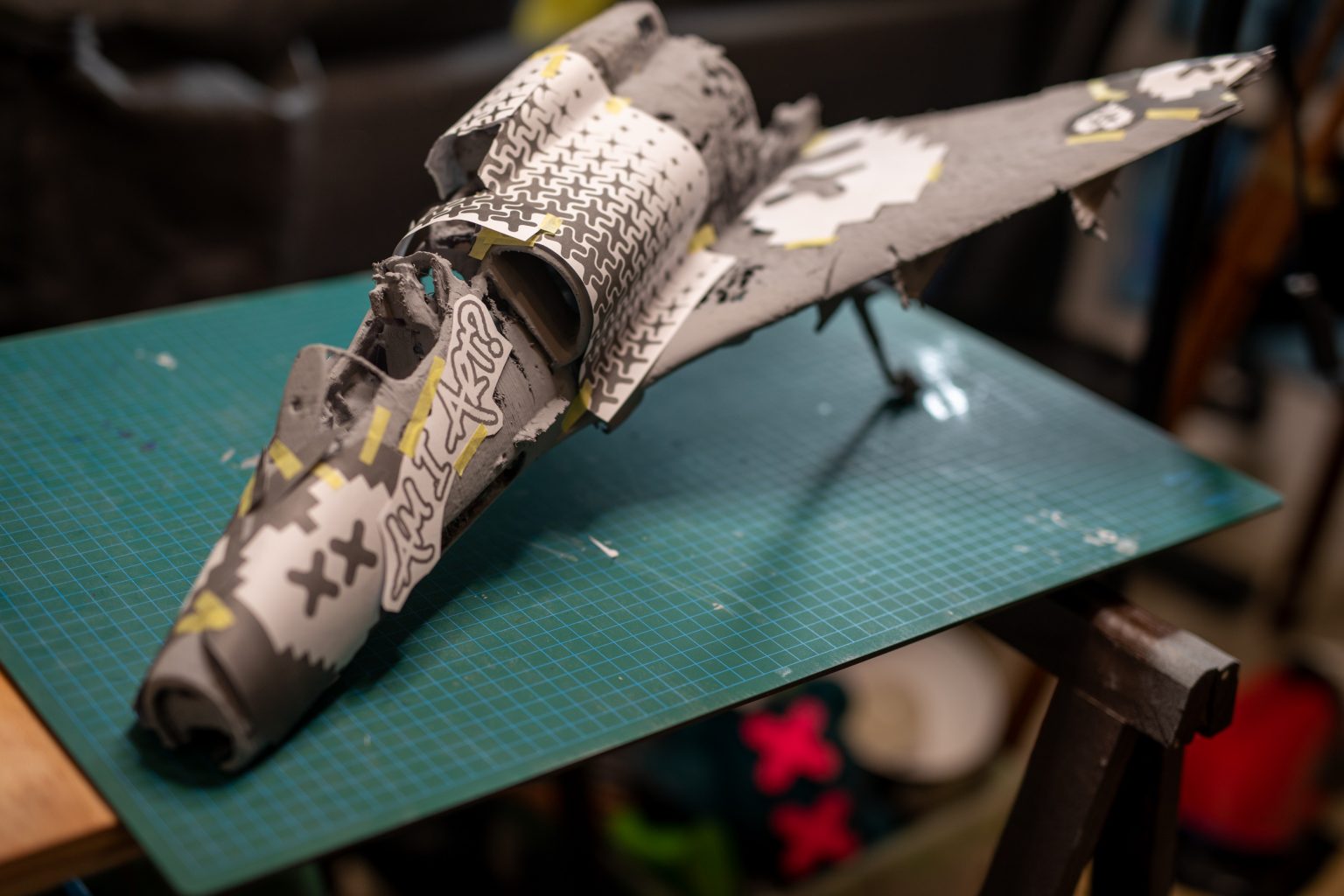
The air in Buri usually smells of dust and the faint, sweet scent of date palms. It is a quiet corner of Bahrain, a place where the rhythm of life is dictated by the call to prayer and the shifting heat of the desert sun. But on a Tuesday night that should have been unremarkable, that rhythm was broken by a sound that didn't belong to the earth.
It wasn't the low rumble of a passing truck or the distant hum of a commercial jet descending toward Manama. It was a scream. A mechanical, supersonic shriek that tore through the atmosphere, followed by an explosion so violent it rattled the windows of homes miles away. When the smoke cleared, the inhabitants of Buri found their streets littered with jagged shards of high-grade aluminum and scorched electronics.
They weren't looking at the remnants of a local accident. They were looking at the debris of a geopolitical shadow war.
The Anatomy of a Falling Star
To understand what fell on Buri, you have to look past the charred metal and into the cold logic of global defense. Analysis of the wreckage—specifically the distinctive seeker head and the layout of the internal wiring—points to a specific culprit: the MIM-104 Patriot missile. This is not a weapon of offense. It is a shield, a multi-million dollar interceptor designed to swat ballistic missiles out of the sky before they can rain fire on cities or oil fields.
But shields can break. Sometimes, they fall.
Imagine a specialized computer, moving at several times the speed of sound, trying to solve a calculus problem in a fraction of a second while hurtling through a dark sky. That is the Patriot system. It is a marvel of engineering. Yet, when a piece of that marvel ends up in a residential street, the technical brilliance matters far less than the origin of the finger on the trigger.
The fragments found in Bahrain bear the unmistakable hallmarks of U.S. manufacturing. This isn't surprising in a vacuum; the United States sells these systems to its allies across the Gulf to provide a "protective umbrella." However, the specific configuration of the debris found in this blast suggests something more intimate than a mere export.
The Ghost in the Machine
There is a significant difference between a weapon owned by an ally and a weapon operated by a superpower. In the wake of the Buri incident, evidence has mounted suggesting that the missile involved was likely U.S.-operated. This distinction is subtle to a casual observer but monumental to a diplomat.
If a Bahraini unit fires a missile and it malfunctions, it is a local tragedy. If a U.S. unit stationed on a foreign base fires that same missile, it becomes a statement of direct kinetic involvement. It means the "invisible hand" of Western defense is no longer just providing the tools—it is actively pulling the cord.
Consider the hypothetical case of a young radar technician sitting in a darkened van, eyes strained against the glow of a green-tinted monitor. We’ll call him Miller. Miller isn't a politician. He’s twenty-three, thousands of miles from home, and responsible for a sector of sky that feels infinite. When a blip appears—a potential drone, a stray rocket, or even a technical ghost—he has seconds to decide.
The Patriot system is designed to take the human out of the loop as much as possible to ensure speed. But the human is always there, holding the ultimate responsibility. When Miller, or someone like him, confirms a target, the machinery of the military-industrial complex is set in motion. The rocket motors ignite. The neighborhood shakes. And sometimes, the target isn't there, or the missile loses its way.
Why the Silence is So Loud
In the aftermath of the blast, the official channels remained strikingly quiet. This silence is a deliberate architecture. To acknowledge a U.S.-operated Patriot launch over Bahraini soil is to admit to a level of active combat readiness that many in the region find provocative. It raises uncomfortable questions about sovereignty and the true cost of protection.
Why was it fired?
The region has become a dense thicket of "unidentified aerial phenomena"—not the kind involving little green men, but the kind involving cheap, loud, and effective kamikaze drones. These drones are the asymmetrical answer to the billion-dollar Patriot. They are slow, they are small, and they are designed to force the defender to waste an expensive interceptor on a plastic toy.
When a Patriot is launched, it is an admission of threat. Whether that threat was real or a sensor malfunction, the result for the people on the ground is identical: a rain of debris. The "invisible stakes" here aren't just about who owns the missile, but who bears the risk when the defense fails. The residents of Buri are living under a roof they didn't build, maintained by people they don't know, using logic they aren't allowed to see.
The Weight of the Shrapnel
To the engineers at Raytheon, a Patriot missile is a series of successful tests and optimized flight paths. To a strategist in Washington, it is a chess piece used to signal resolve to adversaries. But to the person standing over a crater in their backyard, the missile is a terrifying reminder of their own insignificance in the grand theater of war.
The debris in Bahrain wasn't just metal; it was a physical manifestation of a broken promise. The promise of the Patriot is total security—the idea that the sky can be policed so effectively that war becomes something that happens "up there," far away from the kitchen table.
But Buri shows us that the "up there" eventually comes down.
The technical analysis of the wreckage—the specific serial numbers, the cryogenically cooled seeker components—paints a picture of a world where technology has outpaced our ability to manage its consequences. We have created shields so powerful that even their failures are catastrophic.
The reality of 2026 is that the lines between "peace" and "conflict" have blurred into a gray haze of interceptors and decoys. We live in an era of the "almost-war," where missiles are fired in the middle of the night and neither side wants to talk about it the next morning. It is a nervous, twitchy kind of existence.
The Logic of the Intercept
The Patriot system uses a "track-via-missile" guidance system. It’s an elegant solution: the ground radar illuminates the target, the missile sees the reflection, and they talk to each other constantly to refine the intercept point. It is a conversation held in bits and bytes, traveling at Mach 4.
$v = \frac{d}{t}$
This simple formula governs the life and death of the intercept. If the time ($t$) is too long, the distance ($d$) becomes a disaster. But in the rush to minimize $t$, the system can misidentify a flock of birds, a weather balloon, or a technical glitch as a lethal threat.
When the "likely U.S.-operated" tag is applied to this incident, it suggests that the most sophisticated eyes in the world were the ones that saw a threat where perhaps there was none—or were forced to engage a threat that was so close to a civilian area that the debris was inevitable. Either way, the "human-centric" truth is that the shield is just as heavy as the sword.
A Sky Full of Questions
We often think of modern warfare as a series of clean, digital strikes. We watch filtered footage of targets being neutralized with clinical precision. We forget that every action in the sky has an equal and opposite reaction on the ground.
The Bahrain blast wasn't a fluke; it was a symptom. It was a reminder that the high-tech defense systems we rely on to keep the world stable are subject to the same laws of physics and human error as everything else. They are built by humans, operated by humans, and, ultimately, they fall on humans.
The fragments in the sand of Buri are cooling now. The investigators have taken their measurements, and the diplomats have drafted their non-committal statements. But the residents still look up when they hear a loud noise in the night. They no longer see the sky as a vast, empty space. They see it as a ceiling that could collapse at any moment.
There is no holism in a missile strike. There is only the jagged edge of the metal and the silence that follows the boom. We are left to wonder how many more of these "ghost launches" are happening in the dark, and how long we can keep pretending that the shield doesn't leave scars of its own.
The desert wind will eventually cover the scars in the pavement, but it cannot blow away the realization that in the game of global defense, the people on the ground are rarely the ones holding the controller. They are simply the ones waiting to see where the pieces land.
A father in Buri stands in his doorway, looking at the spot where the sky broke. He isn't thinking about serial numbers or U.S. foreign policy. He is thinking about his daughter’s bedroom, twenty yards from the impact. He is thinking about how a piece of a "shield" almost became her tombstone. He turns back inside, but he doesn't turn off the light. He stays awake, listening to the silence, wondering if the next scream from the sky will be the one that doesn't miss.