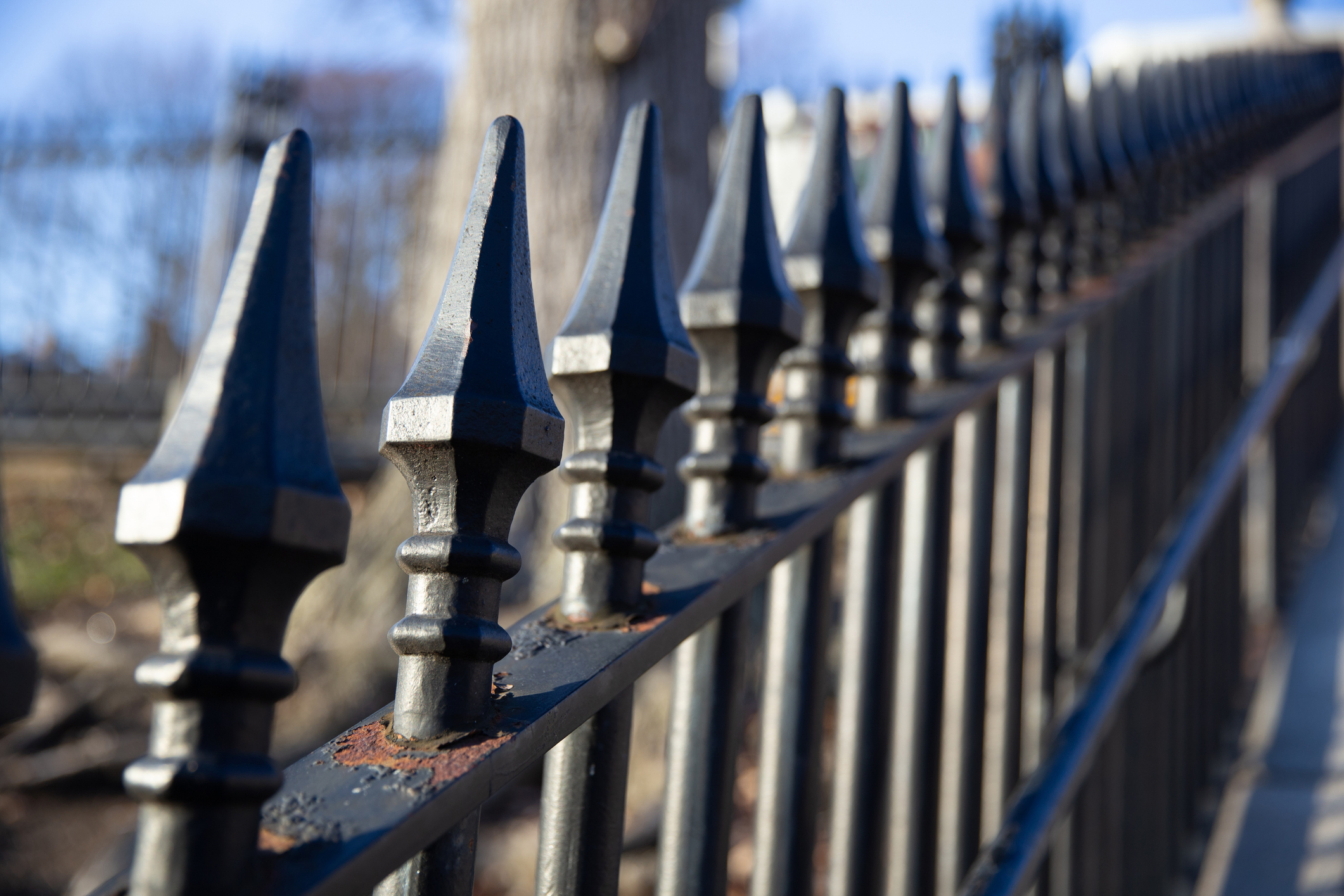
The steel arrived in the gray light of a Tuesday morning. It didn't announce itself with a ribbon-cutting or a public notice pinned to a community board. Instead, it arrived with the rhythmic, industrial thud of post-drivers echoing against the brickwork of a quiet residential block. By noon, the view that many had paid thirty years of mortgages to secure—the simple, unadorned sight of a public park—was being sliced into segments by a six-foot wall of galvanized chain link.
Privacy is a luxury, but visibility is a right. Or at least, that is what we tell ourselves until the property lines are redrawn.
For the residents of this neighborhood, the fence was more than a boundary. It was a sudden, metallic gag. It wound around the perimeter of what used to be a shared shortcut to the grocery store and a patch of grass where kids learned to ride bikes without the fear of traffic. Now, it is a cage. To understand the outrage, you have to look past the physical wires and into the psychological architecture of a home. A house is a sanctuary, but its value—emotional and financial—is dictated by its connection to the world outside. When you sever that connection without warning, the sanctuary becomes a cell.
The Geography of Exclusion
Consider Margaret. She is a hypothetical composite of the three dozen residents currently circulating a petition, but her grievance is entirely real. For two decades, Margaret’s morning ritual involved drinking coffee while watching the sun hit the oaks in the commons. It was a small, free pleasure.
One afternoon, she walked out to her patio and found a workman bolting a tension wire to a post three feet from her back door. When she asked who authorized the barrier, the man shrugged. He was just following a work order from a developer who had recently acquired a sliver of land that everyone assumed was public. This is the "mystery" at the heart of the conflict: a tangled web of "zombie" deeds and overlooked easements that allow private entities to reclaim land that has functioned as public space for generations.
The law is often a cold, binary thing. You either own the dirt or you don’t. But communities aren't built on deeds; they are built on "prescriptive easements"—the unwritten rules of where people walk, where they play, and where they look. When a developer "traps" a neighborhood behind a fence, they are technically exercising a property right. Socially, however, they are committing an act of urban vandalism.
The Invisible Stakes of the View
There is a specific kind of claustrophobia that sets in when your line of sight is truncated. Architects call it "visual permeability." It is the reason we pay more for hotel rooms with balconies and why we fight over window seats on airplanes. Humans are biologically wired to seek expansive vistas; it is a primal signal of safety and opportunity.
When that vista is replaced by a diamond-patterned grid of wire, the brain shifts. The "mystery fence" isn't just an eyesore. It is a constant, physical reminder of powerlessness.
The statistics on urban green space and mental health are not ambiguous. Proximity to open, accessible land reduces cortisol levels and increases social cohesion. When you fence off a park, you aren't just moving a boundary line; you are increasing the physiological stress of everyone living in its shadow. The residents described feeling "trapped," not because they couldn't leave their front doors, but because their spirits were suddenly hitting a wall every time they looked out the window.
The Paper Trail to Nowhere
In cases like these, the bureaucracy is the second cage. The residents went to the City Council. The Council pointed to the Planning Commission. The Commission pointed to a decade-old zoning map that showed the "park" was actually a "private outlot."
This is where the human element gets crushed by the weight of administrative indifference. To the city, it’s a clerical correction. To the person whose toddler can no longer reach the playground without walking a mile around a jagged perimeter, it’s a betrayal of the social contract.
The developer, often an LLC with a name like "Green Vista Holdings" (the irony is rarely lost on the victims), rarely shows a face. They operate through lawyers and permits. They see a "robust" opportunity to "leverage" a forgotten asset. They don't see the path worn into the grass by twenty years of footsteps. They don't see the elderly neighbor who used that shortcut to avoid a steep hill.
The Cost of a Quiet Life
We often think of property disputes as wealthy people fighting over hedges. But this is different. This is about the erosion of the "commons."
Throughout history, the "Enclosure Acts" in England saw common land fenced off for private sheep grazing, driving peasants into the slums of the industrial revolution. We are seeing a modern, suburban echo of that history. Bit by bit, the "mystery" fences go up. A vacant lot here, a wooded path there.
The defense is always the same: "It's my land."
And yet, a community is not a collection of isolated islands. It is a network. If everyone fenced their property to the absolute limit of their legal right, our cities would be nothing but a labyrinth of narrow corridors. We trade a little bit of our "total control" for the benefit of living in a place that feels open, breathable, and kind.
The outrage in this neighborhood stems from the realization that this kindness is optional. It can be revoked by a silent wire-cutter in the middle of the night.
A New Geometry
The residents are now fighting back, but the odds are stacked. They are learning about "adverse possession" and "implied dedication"—legal theories that essentially argue if the public uses a space long enough, it becomes theirs. It is a grueling, expensive way to prove that a sunset shouldn't be for sale.
The fence remains. It is cold to the touch. It smells of zinc and rain.
On a recent evening, a group of neighbors gathered on their respective sides of the wire. They couldn't shake hands, so they pressed their palms against the mesh, their fingers overlapping in the small gaps. They talked through the wire, their voices muffled by the wind. They are no longer just neighbors; they are inmates of a shared circumstance, looking through the grid at a world that used to be theirs to walk upon.
The fence hasn't just divided the land. It has defined it. Before, the park was just there—taken for granted, like the air. Now, it is a lost kingdom. The grass on the other side looks greener, not because it is better maintained, but because it is forbidden.
The sun set that evening, as it always does. But for the families on the block, the light didn't wash over their yards in a golden wave. It was chopped into thousands of tiny, flickering diamonds by the steel mesh, a broken mosaic of a horizon that no longer belongs to them.
One man stood at his back gate, his hand resting on the new lock. He didn't look at the park. He looked at the post, driven deep into the earth, solid and unmoving. He realized then that the fence wasn't there to keep people out. It was there to tell them exactly where they ended.
Would you like me to research the specific legal precedents for prescriptive easements in your local jurisdiction to see if there are grounds for a similar challenge?