In a nondescript room buried beneath the rolling hills of the English countryside, a technician stares at a screen that technically belongs to him, yet operates on a permission slip signed four thousand miles away. He is part of a silent fraternity charged with the ultimate responsibility, the kind that keeps the world spinning on its axis through the sheer terror of what might happen if it stopped. But there is a glitch in the quiet majesty of British sovereignty. It is the ghost in the machine.
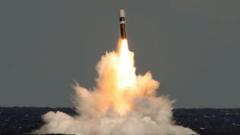
The United Kingdom is a nuclear power. That is the fact we are taught in school, the one repeated in Parliament, and the one that supposedly buys us a seat at the top table of global geopolitics. Yet, if you peel back the Union Jack, you find the Stars and Stripes stitched into the motherboard. Our current deterrent, the Trident system, is a lease-hold agreement. We own the submarines. We own the warheads. But the missiles—the actual delivery vehicles that turn a static threat into a credible one—are part of a shared pool maintained by the United States.
We are a nation with a high-performance car who doesn’t own the keys to the ignition.
The Liberal Democrats have recently broken a long-standing political silence to point out this uncomfortable truth. They are calling for the UK to develop its own sovereign missile technology, ending a decades-long reliance on Washington. It sounds like a dry policy shift. In reality, it is a question of whether a nation can truly be free if its ultimate survival is contingent on the political whims of a foreign capitol.
Consider a hypothetical scenario, one that feels less like fiction with every passing election cycle. A crisis erupts in the North Atlantic. The UK's interests are directly threatened, but the administration in Washington is currently gripped by an isolationist fever. They decide that intervening, even through the passive support of our shared defense systems, isn’t worth the domestic political cost. In that moment, the "special relationship" isn't a bond; it’s a bottleneck.
Independence is heavy. It is expensive. It is technically exhausting. But the alternative is a slow erosion of agency.
The technical reality of our current setup is a marvel of engineering and a nightmare of logistics. Every few years, our missiles are swapped out at a naval base in Georgia, USA. They are refurbished, updated, and cycled back into the fleet. It is efficient. It is cost-effective. It also means that if the US decided to close the shop, the British deterrent would have a shelf life shorter than a high-street loaf of bread. We aren't just buying security; we are renting a shadow.
Moving toward a homegrown missile system isn't about aggression. It is about the fundamental psychology of a state. If you cannot defend yourself without asking for a password from a neighbor, are you actually defending yourself? Or are you just a protectorate with a fancy flag?
The cost of building a domestic missile program is staggering. We are talking about billions of pounds diverted from schools, hospitals, and infrastructure. It is easy to look at those numbers and recoil. It is easy to say that in a world of cyber warfare and pandemics, the big metal tubes in the ocean are relics of a Cold War fever dream. But the Liberal Democrats’ pivot suggests a realization that the world is returning to a state of hard borders and harder choices.
The invisible stakes are found in the rooms where treaties are signed. When a British Prime Minister sits across from a global adversary, there is a weight to their words. That weight is derived from the assumption of total autonomy. If that adversary suspects that the UK’s sword can be sheathed by a phone call from the White House, the Prime Minister isn't a player. They are a proxy.
To build our own system, we would have to rediscover an industrial muscle that has been allowed to atrophy. We would need to pour resources into propulsion physics, guidance systems, and material sciences at a scale not seen since the 1950s. This isn't just about the military. It’s about the sovereign capacity to innovate. It’s about ensuring that the brightest minds in British engineering aren't just maintaining American hardware, but dreaming up our own.
Sovereignty is a word politicians love to shout from podiums, but it is rarely defined by what we can do. It is defined by what we can do alone.
The debate sparked by the Lib Dems isn't just about warheads and telemetry. It’s about the quiet, terrifying realization that the safety net we’ve relied on since the end of the Second World War is fraying at the edges. The world is getting louder. The alliances we thought were written in stone are proving to be etched in sand.
There is a specific kind of vulnerability in realizing you’ve outsourced your soul to a landlord who might decide to sell the building. We have spent seventy years pretending the lease was a deed. Now, the bill for the truth is finally coming due.
Imagine that technician again. He is checking the seals on a hatch. He knows the math. He knows the range. But deep down, he also knows that his finger on the trigger only matters as long as someone in another time zone keeps the lights on. That is the human core of the nuclear debate. It isn't about the blast radius. It’s about the tether. And tethers, no matter how golden or "special" they are, are still just ropes that can be cut.
The choice ahead isn't between war and peace. It’s between being a nation that stands on its own two feet or one that remains perpetually on its knees, waiting for a signal that might never come.