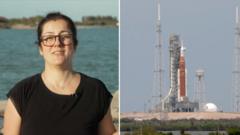
Florida is currently a pressure cooker of liquid hydrogen and human expectation. While the crowds gathering along the Space Coast are there for the spectacle of the most powerful rocket ever built, the technical reality behind the Artemis mission involves a precarious balance of aging infrastructure and unproven systems. The primary mission is not just a return to the moon; it is a stress test for a NASA bureaucracy trying to prove it can still manage a deep-space program in an era where private companies are moving twice as fast for half the cost.
For the spectators in Titusville and Cocoa Beach, the roar of the engines represents a nostalgic return to the glory of the Apollo era. But for those of us who have spent decades tracking the shifting tides of aerospace procurement, the view is more complicated. This launch is the culmination of a decade of political compromise and budget battles. It is the moment where the Space Launch System (SLS) must finally justify its multibillion-dollar existence or risk becoming a historic footnote of inefficiency.
The Mechanical Cost of Nostalgia
The SLS is often described by critics as a "Frankenstein" rocket. This isn't just an insult; it is a literal description of its engineering. To save time and money—though it arguably did neither—NASA designed the rocket using components left over from the Space Shuttle program. The core stage uses RS-25 engines that actually flew on shuttle missions. The solid rocket boosters are extended versions of the same technology that powered flights in the 1980s.
Relying on legacy hardware creates a unique set of headaches. These engines were designed to be refurbished and reused, yet on the SLS, they are being dropped into the ocean after a single use. It is like taking a vintage Ferrari engine and driving it off a cliff because you don't have a garage. This approach was meant to provide a "safe" and "proven" path to the moon, but the complexity of integrating 40-year-old designs with modern digital flight software has caused years of delays.
The thermal protection systems and the mobile launcher platform have also faced grueling hurdles. During wet dress rehearsals, the ground systems struggled with the volatile nature of cryogenic propellants. Liquid hydrogen is a notoriously difficult substance to manage; its molecules are so small they can find leaks in seals that appear airtight under any other condition. When you see a scrub at the last minute, it is usually because physics is winning the battle against hardware that was conceived in a different century.
The Economic Reality of the Space Coast
While the technical risks are immense, the economic impact on Florida is immediate and undeniable. The Space Coast has undergone a massive transformation since the shuttle retired in 2011. Back then, the region was a ghost town of empty motels and shuttered engineering firms. Today, it is a bustling hub where NASA technicians rub shoulders with SpaceX crews and Blue Origin builders.
This revival isn't just about one rocket. It is about the infrastructure required to support a permanent human presence in space. The hotels are at 100% capacity, and local businesses are seeing record numbers, but this boom is built on a fragile foundation. If Artemis I fails to meet its primary objectives—specifically the survival of the Orion capsule during a high-speed reentry into the Earth's atmosphere—the political will to fund the subsequent crewed missions could evaporate.
The cost per launch for the SLS is estimated at roughly $2 billion. When you add the development costs, each flight becomes a significant portion of NASA's annual budget. For the price of one Artemis launch, the agency could theoretically buy dozens of missions on commercial heavy-lift vehicles. This creates a tension that defines the modern aerospace industry: the struggle between a government-owned "national" rocket and a commercially driven marketplace.
The Orion Shield and the Reentry Problem
The most critical moment of the entire mission occurs long after the smoke clears from the Florida pad. It happens when the Orion spacecraft hits the atmosphere at 25,000 miles per hour. At that speed, the friction of the air creates temperatures nearly half as hot as the surface of the sun.
Orion uses an ablative heat shield designed to char and fall away, carrying the heat with it. This is a design philosophy that dates back to the Mercury and Apollo days, but on a much larger scale. If the shield has even a minor manufacturing flaw, the results would be catastrophic. This flight is uncrewed for a reason. NASA needs to know if the sensors inside the capsule, mimicking human bone and tissue, can survive the radiation and the G-forces of a lunar return.
There is also the matter of the European Service Module. For the first time, NASA is relying on an international partner, ESA, to provide the "powerhouse" of the spacecraft. It handles propulsion, power, and thermal control. If that module fails while Orion is in a distant retrograde orbit around the moon, the capsule becomes a multi-ton piece of space junk with no way home.
Political Inertia Versus Commercial Speed
The Artemis program exists because it satisfies a specific political appetite. It keeps thousands of high-skilled jobs distributed across all 50 states, ensuring that no matter who is in the White House, the program has enough votes in Congress to survive. This is the "Senate Launch System" moniker that has followed the rocket since its inception.
Contrast this with the development of the Starship program in South Texas. There, the philosophy is "fail fast, fix fast." They blow up prototypes to find the breaking point. NASA cannot afford to do that. A single explosion on the pad at Kennedy Space Center would trigger years of congressional hearings and likely end the program entirely. This makes the agency's approach incredibly conservative, leading to the "gold-plated" engineering that makes the SLS so expensive.
However, the SLS has one thing that private rockets currently lack: a flight-proven capability to send a fully integrated, man-rated capsule to the moon in a single shot. While companies like SpaceX are working on refueling in orbit—a necessary step for their lunar plans—NASA is sticking to the "one big rocket" method. It is a brute-force approach to orbital mechanics.
The Invisible Threat of Space Weather
One factor that rarely makes the headlines during launch day is the impact of solar radiation. Once a spacecraft leaves the protective envelope of the Earth's magnetic field, it is exposed to high-energy particles from the sun. The Artemis mission is flying during a period of increasing solar activity.
Orion's shielding and its internal electronics have been hardened to withstand these bursts, but the "Deep Space" environment is unpredictable. A solar flare during the transit could fry sensitive communication equipment. The mission's success depends on more than just the engines firing correctly; it depends on the sun behaving itself for the duration of the multi-week flight. This is why the mission's timing is so meticulously planned, balanced between launch windows, lunar alignment, and solar cycles.
Redefining the Goal Post
We have to ask what "success" actually looks like for this mission. Is it just the launch? Is it the moon orbit? Or is it the safe recovery of the capsule?
For the industry analyst, the answer is none of the above. Success is the collection of data. Even a total failure provides a roadmap of what not to do next time. But for the public, who are footing the bill, anything less than a perfect splashdown in the Pacific will be seen as a sign that the U.S. has lost its edge.
The pressure on the launch directors in the firing room is immense. They aren't just managing a countdown; they are managing the reputation of a superpower. When the "go/no-go" poll is taken, the voices you hear aren't just checking off systems. They are committing to a path that has no off-ramp.
The spectators on the beach see the flame and feel the vibration in their chests. They see a symbol of American greatness. But if you look closer at the telemetry, you see a program that is running out of time to prove its relevance. The SLS must fly, and it must fly perfectly, because the alternative is a slow slide into obsolescence.
Infrastructure and the Ghost of Apollo
Walking around Launch Complex 39B is a lesson in historical layering. The pad was originally built for Apollo, modified for the Shuttle, and has now been stripped and rebuilt for Artemis. This reuse of space is poetic, but it introduces hidden costs. The "Crawlerway" that carries the massive rocket from the Vehicle Assembly Building to the pad has to be reinforced with specific types of river rock to handle the weight of the SLS, which is significantly heavier than its predecessors.
Every time the rocket is rolled out and then rolled back due to weather or technical issues, the stress on the airframe and the sensitive electronics increases. The hardware is not meant to be moved back and forth indefinitely. The seals degrade, the sensors drift, and the human teams become fatigued. The "excitement" in Florida is often tempered by this mechanical exhaustion.
The local community understands this better than anyone. They know that a "scrub" isn't just a delay; it's a drain on resources. The crews working the late shifts at the Kennedy Space Center are the ones who have to deal with the reality of a 300-foot-tall tower of explosives sitting in the salty, humid Florida air. Corrosion is a constant enemy. Every day the rocket sits on the pad, the environment is trying to eat it.
The Long Road to Mars
NASA's marketing materials emphasize that Artemis is a stepping stone to Mars. This is a bold claim, but the logistics suggest otherwise. The SLS, in its current configuration, is a lunar-centric vehicle. To get to Mars, we would need a fleet of these rockets or a completely different propulsion technology that doesn't yet exist in a scalable form.
This mission is more about establishing a sustainable presence in lunar orbit through the Gateway station. It is about learning how to live and work in a place where "home" is three days away instead of three hours. If we cannot master the lunar environment, Mars remains a fantasy. The Artemis launch is the first real test of whether we have the stamina for long-term space habitation.
The mission's trajectory will take Orion 40,000 miles beyond the far side of the moon—further than any spacecraft built for humans has ever traveled. In that silence and distance, the political bickering and budget concerns of Earth will seem trivial. But they will be waiting as soon as the capsule hits the water.
The future of American spaceflight is currently sitting on a pad in Florida, fueled by 700,000 gallons of cryogenic propellant. The margin for error is zero. The cost of failure is astronomical. And the world is watching to see if we still know how to reach for the stars without tripping over our own feet.
Keep a close eye on the telemetry coming out of the Orion capsule during its transit through the Van Allen radiation belts. The data recorded there will determine the shielding requirements for the crewed Artemis II mission and could force a complete redesign of the interior cabin if the levels are higher than current models predict.