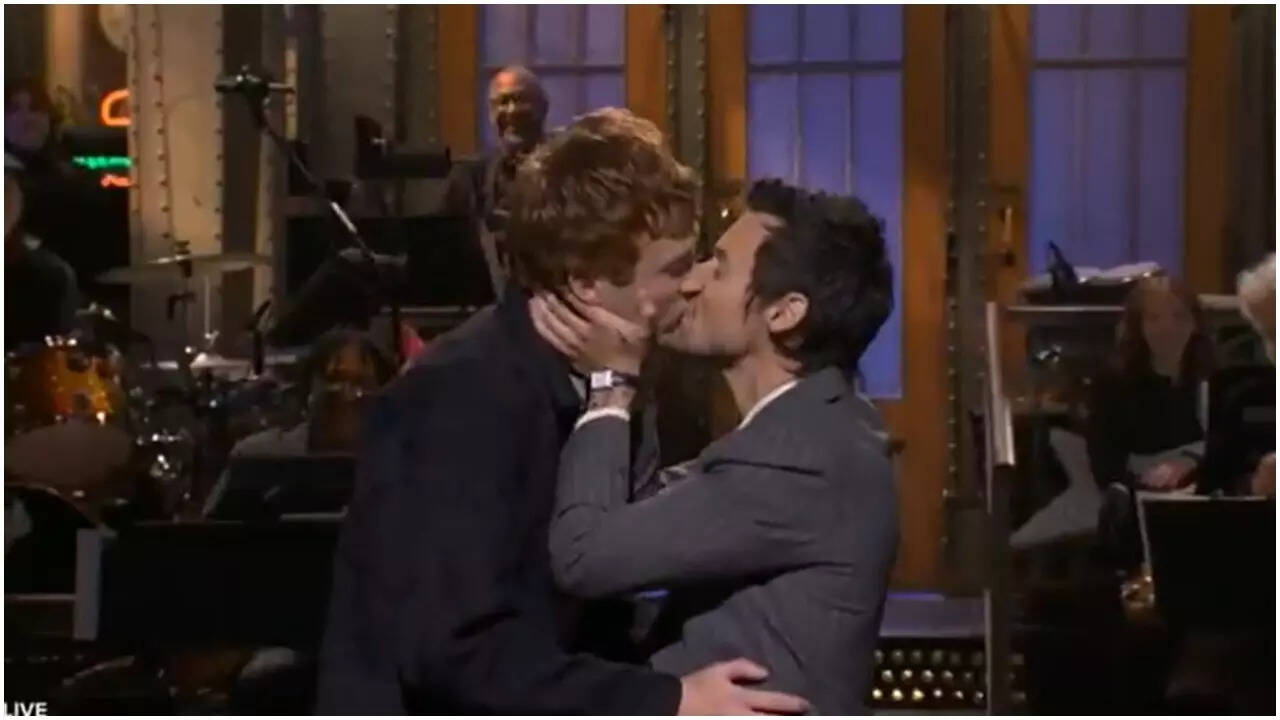
The air in Studio 8H always smells slightly of floor wax and frantic adrenaline. It is a space where the walls are steeped in decades of calculated risk, where the line between a scripted joke and a cultural manifesto is thinner than a camera lens. On this particular Saturday night, the man at center stage stood wrapped in the effortless confidence of a modern deity. Harry Styles, a man who has turned the act of getting dressed into a global conversation, was finishing his monologue.
Then came the kiss.
It wasn't a tentative moment. It was a firm, deliberate planting of lips on a male comedian, a punctuating mark at the end of a comedic sentence. The audience roared. The internet, predictably, fractured. In the quiet living rooms of fans and the loud offices of cultural critics, the same word began to ripple through the digital ether: queerbaiting.
To understand why a simple kiss on a comedy show carries the weight of a geopolitical event, you have to look past the velvet suits and the painted nails. You have to look at the silent contract between a star and an audience that is starving for something real.
The Architecture of the Tease
Imagine a young person in a small town, someone who feels like their own identity is a puzzle with missing pieces. They look at a global icon like Styles—someone who leans into the feminine, who wears the pearls, who dances in the blurred lines of gender—and they see a mirror. They see a possibility. To that fan, these aesthetic choices aren't just fashion. They are breadcrumbs.
But breadcrumbs only matter if they lead to a house.
The tension of the SNL kiss lies in the ambiguity. When a straight-identifying or "unlabeled" artist adopts the visual language of the LGBTQ+ community without ever claiming the struggle that comes with it, they are walking a tightrope over a very specific kind of resentment. It is the resentment of those who had to fight for the right to wear those same pearls without being mocked, or worse.
Queer identity is not a costume. It is a lived reality involving systemic hurdles, familial rejection, and a history of erasure. When a celebrity "performs" queerness as a marketing tool—to build a brand that feels edgy, inclusive, or mysterious—it can feel like a heist. It’s taking the aesthetic of the revolution while avoiding the frontline.
The Invisible Stakes of the Spotlight
Consider the hypothetical case of a brand manager named Sarah. Sarah’s job is to ensure her client remains "relevant." In the modern economy of attention, "relevant" often means "disruptive." She knows that a traditional monologue is forgettable. She knows that a shocking headline is a currency.
"Give them something to talk about," she might say.
This is the cold machinery behind the warm glow of the television screen. The kiss on SNL wasn't just a moment of spontaneous affection; it was a beat in a larger rhythmic cycle of public engagement. The problem is that while the celebrity and their team see a "moment," the community being referenced sees their life’s work being used as a prop.
Styles has famously guarded his privacy, refusing to put a neat, marketable label on his sexuality. In many ways, this is a radical act of autonomy. Why should he owe the public a confession? Why can’t a man just be a man who likes sequins and kissing his friends? In a perfect world, that would be the end of the story.
But we don't live in a vacuum. We live in a world where representation is a scarce resource. When a high-profile figure occupies the space meant for queer representation but refuses to acknowledge the community's reality, they create a vacuum. They invite the "queerbaiting" accusation because they are teasing a narrative they refuse to finish.
The Weight of the Painted Nail
There is a specific kind of exhaustion that comes with being a fan of someone who constantly winks at you but never speaks your name. It’s the feeling of being invited to a party only to realize you’re the entertainment, not the guest.
The SNL kiss was, in the vacuum of a comedy sketch, harmless. It was a classic "shock" gag that has been used by straight comedians for decades to elicit a cheap laugh from a "straight" audience. That is precisely why it stung for so many. By using a man-on-man kiss as a punchline, the show reverted to an old, tired trope: the idea that two men kissing is inherently hilarious because it is "weird."
If the kiss was meant to be a statement of solidarity or fluidity, the comedic context undermined it. If it was meant to be a joke, it relied on a foundation of homophobia—the "ew/wow" factor.
This is where the human element gets messy. We want our idols to be avatars of progress. We want them to be the brave pioneers of a new, gender-neutral frontier. But sometimes, they are just people navigating a business that rewards ambiguity. Styles is a master of the "maybe." He exists in the "perhaps." And while that is a beautiful place for an artist to live, it is a frustrating place for a community looking for a champion.
The Mirror and the Mask
A mirror reflects what is in front of it. A mask hides what is behind it. For years, the public has been trying to figure out which one Harry Styles is holding.
Every time he steps out in a dress or shares a stage-managed intimate moment with a man, he is holding up a mirror to a generation that values self-expression above all else. But to those who have bled for that expression, it can start to look like a mask. A way to be "queer-coded" for the aesthetic benefits while retaining the "straight-passing" privilege that protects him from the harshest edges of reality.
The conversation isn't really about Harry Styles. It’s about us.
It’s about our desperate need to see ourselves reflected in the gods of our culture. We project our hopes, our traumas, and our identities onto these people, and when they don't hold the weight of those projections exactly how we want them to, we feel betrayed.
The SNL monologue was a performance in every sense of the word. It was a tight, professional, and charming display of charisma. The kiss was the crescendo. But once the lights went down and the makeup was scrubbed off, the comedian went home, the pop star went back to his guarded life, and the audience was left to argue about what it all meant.
We are hunting for authenticity in a medium designed for artifice.
Perhaps the real lesson isn't in whether the kiss was "real" or "bait." Perhaps the lesson is in the reaction itself. The fact that a single kiss can spark a global debate about the ethics of identity proves that we are no longer satisfied with the "wink." We are tired of the tease. We are looking for the person behind the glitter, and we are starting to realize that the person might not be who we need them to be.
The stage is empty now. The echoes of the laughter have faded into the rafters of Studio 8H. But the question remains, hanging in the air like the smell of that floor wax: At what point does a tribute to a community become a caricature of it?
We watch. We wait. We hope for a sign that isn't a punchline.