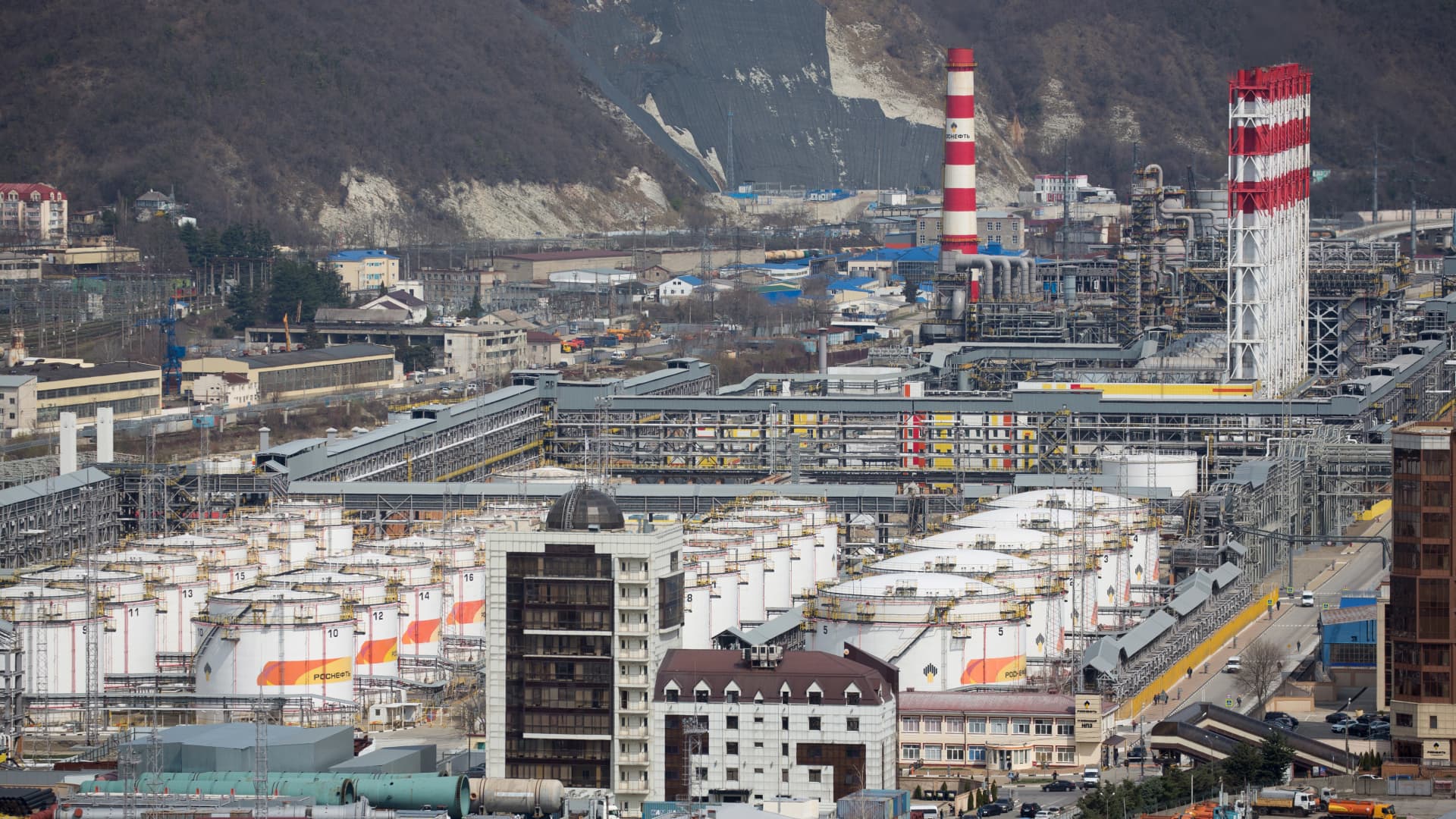
The sudden decoupling of crude oil prices from equity indices following the resolution of military friction is not a market anomaly; it is the mathematical result of Risk Premium Decompression. When geopolitical actors signal that "military goals are complete," they effectively remove the "tail risk" from the supply-side equation, causing an immediate contraction in the cost of hedging. This shift forces a rapid reallocation of capital from defensive commodities into growth-oriented equities as the perceived probability of a global supply chain rupture nears zero.
To understand why the market reacts with such velocity, we must examine the specific transmission mechanisms between executive rhetoric, energy futures, and equity valuation models.
The Architecture of the Geopolitical Discount
Market participants price assets based on the discounted present value of future cash flows. Geopolitical instability introduces a Stochastic Variable into this calculation. When military tensions rise, analysts apply a "Geopolitical Risk Premium" (GRP) to oil, which functions as an insurance layer on top of fundamental supply-and-demand physics.
The statement that military goals are "pretty well complete" acts as a volatility dampener. This creates three distinct market shifts:
- Backwardation Collapse: In periods of conflict, oil markets often enter "backwardation," where the immediate spot price is significantly higher than future delivery prices because buyers are desperate for physical barrels now. De-escalation flattens this curve, signaling that the "scarcity fear" has evaporated.
- Equity Multiple Expansion: High energy costs act as a tax on both consumers and corporations. When the threat of $100+ oil is removed, equity analysts revise their discount rates downward. Lower input costs lead to higher margin expectations, which justifies a higher Price-to-Earnings (P/E) multiple for the S&P 500.
- The Safe Haven Rotation: Capital is finite. In high-friction environments, liquidity pools in "safe havens" like gold, the USD, and crude oil futures. The moment military finality is signaled, this liquidity "unwinds," flowing back into risk assets like technology and small-cap stocks.
The Crude Oil Cost Function: Why Prices Drop
The price of oil is not a single number but a composite of three primary pillars. By categorizing the "military goals complete" statement within these pillars, we can quantify why the drop was inevitable.
Pillar I: The Physical Supply Buffer
Military conflict in energy-producing regions threatens the physical flow of barrels. The "completion" of military goals implies that infrastructure (pipelines, refineries, and shipping lanes) is no longer a kinetic target. This restores the Supply Reliability Coefficient. If the market was pricing in a 5% chance of a 2-million-barrel-per-day disruption, the removal of that 5% probability instantly sheds several dollars off the per-barrel price.
Pillar II: The Logistics and Insurance Surcharge
During active military operations, the cost of shipping oil—specifically "War Risk Insurance"—skyrockets. Tankers traversing contested waters pay massive premiums. When a commander-in-chief signals an end to active hostilities, these operational overheads vanish. The market anticipates this reduction in the "landed cost" of crude, and speculators sell off their positions in advance of the actual price drop at the pump.
Pillar III: The Speculative Momentum Unwind
A significant portion of the oil price during a crisis is driven by "Managed Money" (hedge funds and CTAs). These players trade on momentum and volatility. The statement of military completion serves as a technical "sell signal." As these large-scale players exit their long positions, it creates a cascading effect of stop-loss orders, accelerating the downward price action regardless of the actual physical supply levels at that moment.
Equity Markets: The Relief Rally Framework
While oil falls, stocks rise. This inverse correlation is driven by the removal of Macro-Economic Friction. The "Relief Rally" is a structural re-rating of the entire market based on two core drivers:
1. Operating Margin Recovery
For the majority of non-energy companies in the S&P 500, energy is a significant "Opex" (Operating Expense) variable.
- Logistics/Transport: Airlines and freight companies see an immediate reduction in fuel surcharges.
- Manufacturing: Lower energy costs reduce the "Cost of Goods Sold" (COGS), directly inflating the bottom line without requiring an increase in sales volume.
- Consumer Discretionary: Lower gas prices act as a pseudo-stimulus, increasing the disposable income of the average household, which is then redirected toward retail and services.
2. Certainty as a Valuation Variable
Markets can price in bad news, but they cannot price in uncertainty. The "military goals complete" narrative provides a floor for the downside. It allows corporate CFOs to move from "Crisis Management" back to "Capital Allocation." When a CEO knows that a regional war is unlikely to expand, they are more likely to approve stock buybacks, M&A activity, and R&D spending—all of which are bullish signals for equity investors.
The Relationship Between Executive Rhetoric and Algorithmic Trading
In the modern trading environment, the gap between a public statement and a market move is measured in milliseconds. High-frequency trading (HFT) algorithms are programmed to scan executive transcripts for specific keywords.
The phrase "military goals... complete" triggers a "Risk-On" sentiment score. This leads to a synchronized execution:
- Shorting Crude Oil Futures: Selling "Front-Month" contracts.
- Buying Index Futures: Going long on the E-mini S&P 500 or Nasdaq 100.
- Selling Volatility: Shorting the VIX (Volatility Index).
This algorithmic response creates a self-fulfilling prophecy. The initial "bot-driven" move creates a price trend that human traders then follow, cementing the "Oil Down / Stocks Up" pattern.
Structural Limitations of the De-escalation Bounce
It is a mistake to view this market move as a permanent shift toward a bull market. The de-escalation bounce has inherent limitations that analysts often overlook.
The "Inventory Overhang" Trap
If oil prices fall too far, too fast, it can signal a broader economic slowdown rather than just a peace dividend. If the drop in oil is caused by a lack of demand rather than just a removal of risk, the equity rally will be short-lived. Analysts must distinguish between "De-risking" (bullish) and "Deflationary Demand Destruction" (bearish).
The Re-escalation Sensitivity
When a market rallies on a "goals complete" statement, it becomes hyper-sensitive to any contrary data. A single rogue kinetic event or a contradictory tweet can cause a "Value-at-Risk" (VaR) shock, where the market overreacts in the opposite direction. The "Peace Dividend" is fragile and requires constant rhetorical reinforcement to maintain.
The Inflationary Paradox
Ironically, a massive rally in stocks and a drop in oil can complicate the task of central banks. If the market's "Financial Conditions" loosen too much (because stocks are at all-time highs and energy is cheap), it could reignite inflationary pressures in other sectors, forcing the Federal Reserve to keep interest rates higher for longer. This creates a "Ceiling" on how high stocks can actually go in response to geopolitical de-escalation.
Strategic Execution for Market Participants
The optimal play in this environment requires a bifurcated approach to asset allocation.
Identify the Laggards
In the immediate wake of a geopolitical de-escalation, focus on sectors that were "uninvestable" during the tension. This includes international airlines, chemical manufacturers with high energy inputs, and consumer discretionary brands with global supply chains. These sectors typically lag the initial index rally by 48 to 72 hours as fundamental analysts confirm the de-escalation is holding.
Hedge the Reverse Shock
Since the market has now "priced in" the end of hostilities, the greatest risk is a return to friction. Investors should look at out-of-the-money (OTM) call options on oil volatility (OVX) as a low-cost hedge against the narrative shifting back to conflict.
Analyze the Yield Curve
The most reliable indicator of whether the equity rally is sustainable is the bond market. If Treasury yields remain stable or tick slightly higher during the stock rally, it suggests the move is driven by genuine economic optimism. If yields plummet alongside oil, it suggests the market is actually bracing for a recession, and the "stocks up" move is merely a short-squeeze that will eventually fail.
The transition from a "War Footing" to a "Completion Narrative" shifts the market's focus from survival to efficiency. The current price action is a violent re-calibration of value, stripping away the artificial premiums of fear and replacing them with the cold math of operational margins. Success in this phase belongs to those who trade the decompression, not the headlines.
The strategic imperative now is to monitor the Sustainability of the Bid. Watch the 10-day moving average of the S&P 500 relative to the 200-day moving average of WTI Crude. A widening spread confirms a structural shift in the macro environment; a narrowing spread suggests the "completion" narrative was a temporary sentiment pop rather than a fundamental pivot. Execute on the spread, not the sentiment.