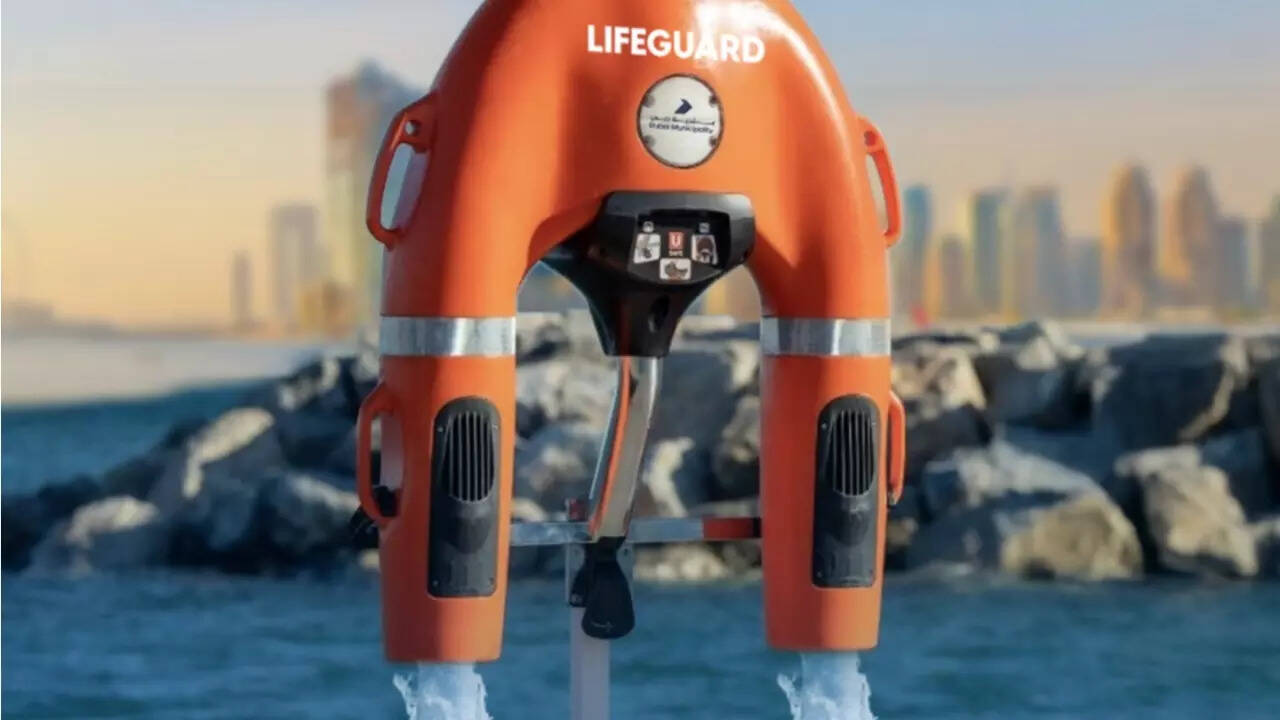
The Dubai Municipality has officially moved past the era of the lone lifeguard with a whistle. On the busy stretches of Al Mamzar and Umm Suqeim, the safety of thousands of swimmers now rests on the silicon shoulders of AI-powered aquatic rescue bots and high-capacity drones. This isn't a pilot program or a flashy tech demo meant for a trade show floor. These machines are active, operational, and capable of towing 500kg—roughly the weight of five or six grown adults—out of a rip current before a human lifeguard could even reach their flippers.
This shift represents a hard pivot in how cities manage public safety in high-traffic tourist zones. While the world watches Dubai for its architectural excess, the real story is the silent automation of the shoreline. By integrating these units into the existing emergency response framework, the city is betting that sensors and propellers can outperform human instinct and physical stamina in the chaotic environment of the Persian Gulf. Meanwhile, you can explore similar events here: The Anthropic Pentagon Standoff is a PR Stunt for Moral Cowards.
The Brutal Physics of a Shoreline Rescue
Water rescue is a game of seconds played against physics. A human lifeguard, no matter how elite, is subject to fatigue, lactic acid buildup, and the unpredictable resistance of the tide. When a swimmer panics, they become a danger to their rescuer.
The "iRescue" units and their drone counterparts remove the biological bottleneck. These robots operate with a mechanical indifference to exhaustion. The aquatic bots are essentially motorized lifebuoys equipped with high-torque propulsion systems. They don't swim; they cut through the surface. When a distress signal is triggered—either by a shore-based observer or an AI-monitored camera feed—the bot is deployed. It reaches speeds that no Olympic swimmer could match, providing immediate buoyancy to multiple victims simultaneously. To see the full picture, we recommend the excellent analysis by Wired.
The 500kg towing capacity is the specific metric that changes the math of a mass-casualty event. In a scenario where a small boat capsizes or a group is pulled out by a sudden current, a single robot can act as a tugboat for human lives. It provides a stable platform for victims to cling to while the drone overhead provides a bird's-eye view to the command center, ensuring no one is missed in the swell.
Behind the AI Surveillance Net
The hardware is the visible part of the operation, but the true intelligence lies in the thermal and optical sensors scanning the water. Traditional lifeguarding relies on "scanning"—a manual process where a human eye moves in a specific pattern across a zone. It is notoriously fallible. Glare, heat exhaustion, and the "distraction effect" of a crowded beach can lead to fatal delays.
Dubai's new system uses computer vision to identify the specific erratic movements associated with drowning. Drowning doesn't look like the splashing and shouting seen in movies; it is often a silent, vertical struggle. The AI is trained to recognize the "Instinctive Drowning Response"—the lateral arm movements and the head-back position—long before the victim's lungs fill with water.
Once the software flags a potential incident, the drone is the first responder. It doesn't just watch. These drones are equipped with rapid-release life jackets and communication systems. They can drop flotation devices directly to a victim within seconds of the initial flag, buying the aquatic bot the time it needs to travel from the shore station. This multi-layered approach creates a safety net that is effectively "always on," regardless of the time of day or the number of people in the water.
The Cost of Autonomy
Critics often point to the high price tag of such systems as a barrier to entry for most coastal cities. A single high-end rescue drone and the accompanying AI infrastructure can cost more than the annual salary of several human lifeguards. However, the business case in Dubai isn't built on saving money—it's built on mitigating risk in a multi-billion dollar tourism economy.
A single high-profile drowning on a public beach has a massive ripple effect on a city’s reputation. By investing in a 24/7 robotic presence, the municipality is essentially purchasing a high-tech insurance policy. There is also the matter of operational reach. These bots can be deployed in sea conditions that would be too dangerous for a human lifeguard to enter. When the red flags are flying and the surf is high, the machines remain viable.
There is a persistent counter-argument that technology creates a false sense of security. If swimmers believe they are being watched by an omniscient AI, they may take greater risks. This "moral hazard" is something beach authorities have to balance with public education. The robot is a tool of last resort, not a license for recklessness.
The Logistics of Maintenance in Salt and Sand
Operating delicate electronics in a marine environment is a nightmare for engineers. Saltwater is corrosive. Sand is abrasive. Heat in the UAE can exceed 45°C, which is enough to fry the batteries of standard consumer drones.
The units deployed in Dubai are ruggedized to a military grade. The aquatic bots use closed-loop cooling systems and sealed internal compartments to prevent brine from reaching the motherboards. The drones use specialized heat sinks to ensure the AI processors don't throttle during a midday rescue.
The maintenance cycle is just as rigorous as the rescue protocols. Every unit undergoes a diagnostic check after every deployment. This isn't just about cleaning the propellers; it’s about recalibrating the sensors to ensure the AI doesn't start misidentifying a floating piece of debris as a human head. The reliability of the system depends entirely on the humans in the workshop, proving that while the bots do the heavy lifting, the human element has simply shifted from the tower to the tech bay.
A Blueprint for Global Coastal Management
Dubai’s implementation serves as a real-world laboratory for other coastal hubs like Miami, Sydney, or Rio de Janeiro. The data being gathered right now—response times, battery endurance under load, and AI accuracy in different light conditions—will likely set the international standard for robotic lifesaving.
We are seeing the birth of a hybrid model. The human lifeguard isn't going away, but their role is evolving into that of a "mission commander." They oversee a fleet of autonomous assets, stepping in only when the complexity of a situation exceeds the logic of the software. It is a more efficient, more powerful, and ultimately more humane way to manage the interface between a city and the sea.
As these systems become more common, the focus will shift from "can they save us" to "how much of our privacy are we trading for that safety." The same cameras that watch for drowning also track every movement on the sand. For now, the trade-off seems worth it to a city that prides itself on being the safest in the world. The next time you see a 500kg-capable drone hovering over the Arabian Gulf, know it isn't just taking photos; it is waiting for the exact moment the physics of the ocean turn against you.
Test the limits of this technology yourself by observing the deployment zones at Umm Suqeim, where the integration of these bots has already reduced emergency response times by an estimated 40 percent.